Guide
What Can a 1000Wh Power Station Run During an Outage
Use published capacities, inverter limits, and a simple watt-hour formula to see what a 1 kWh-class portable power station can and cannot run when the grid goes down.
A “1000Wh” portable power station is a battery with about one kilowatt-hour of stored energy and a built-in inverter. That is enough to keep a short list of essentials going in a blackout — a refrigerator, lights, a router, phones, and a laptop — if you size the inverter correctly and do not treat the 1000Wh label as a promise of ten hours at 100 watts.
This article uses a planning formula, official appliance figures, and the published specifications of four 1 kWh-class stations. It does not include lab tests, prices, or product ratings.
First check the inverter, then the battery
Two different limits matter, and they fail in different ways.
Surge (starting) watts versus running watts. Motors — refrigerator compressors, pumps, some tools — draw a short spike when they start, then settle to a lower running wattage. Honda’s generator wattage estimation guide lists an ENERGY STAR refrigerator or freezer at approximately 1,200 starting watts and 132–192 running watts. If the station’s surge rating is below the spike, the inverter may shut down or the compressor may not start, even if the battery still has charge.
Average watts versus nameplate watts. Runtime is set by energy, in watt-hours, not by the peak the inverter can pass. A fridge that draws ~160 W while the compressor is on may average closer to 40–70 W over a day because the compressor cycles. Use average watts (from annual energy use, or from a meter) to estimate hours, and use running plus starting watts to see whether the inverter can carry the load at all.
High, continuous heating loads are the other hard stop. A 1,500 W space heater on a 1,000 Wh battery, even at 85% efficiency, is a planning estimate of well under an hour: (1000 × 0.85) ÷ 1500 ≈ 0.6 hours.
The runtime formula
For a first estimate:
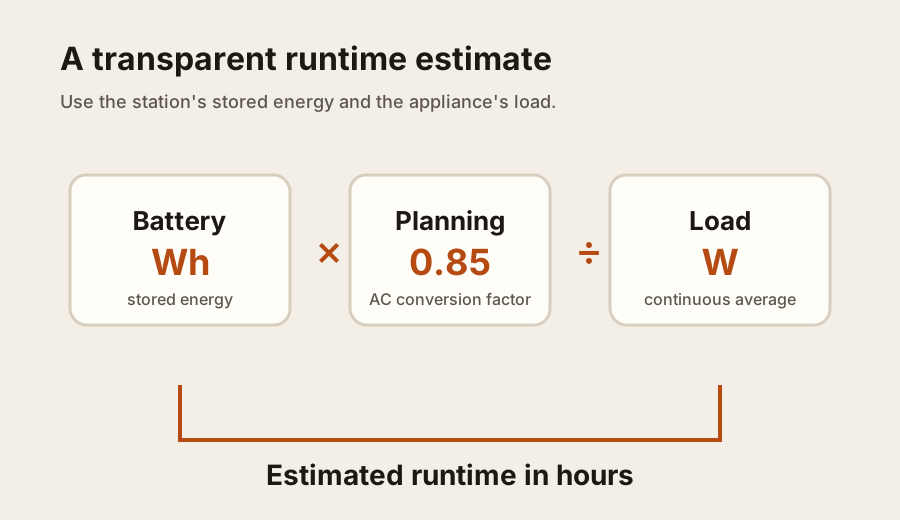
Runtime (hours) ≈ battery capacity (Wh) × inverter efficiency ÷ load (W)
We use 0.85 as a conservative efficiency factor when a brand does not publish inverter efficiency. That factor is a planning assumption, not a measurement of a particular unit.
Some manufacturers publish a more complete version. On the BLUETTI AC180 product page, BLUETTI writes:
running time = Battery capacity × DoD × η ÷ (load power + self-consumption)
and gives DoD (depth of discharge) of 90%, inverter efficiency η of 85%, and self-consumption of about 15 W for that model. Their worked example for a 100 W blender is 1152 × 90% × 85% ÷ (100 + 15) ≈ 7.66 hours. The simple 0.85 formula on the same 1,152 Wh pack would say 1152 × 0.85 ÷ 100 = 9.8 hours. The difference is the reserved capacity and standby draw — both real, and easy to forget.
Temperature, battery age, cable losses, and whether you are using AC or a more efficient DC/USB output will also move the result.
What “1000Wh” means on four published spec sheets
Names in this class are rounded. Published capacities for current 1 kWh-class models are close to, but not exactly, 1000 Wh. The figures below are manufacturer specifications for the regional pages cited, not test results. Several of these US or North American pages specify 120 V AC output.
| Model (published specs) | Capacity | Rated AC output | Surge / peak (as published) | Chemistry | Weight |
|---|---|---|---|---|---|
| EcoFlow DELTA 2 | 1024 Wh | 1800 W total, pure sine wave | 2700 W | LFP (LiFePO4) | About 12 kg / 27 lb |
| Jackery Explorer 1000 v2 (JE-1000D) | 1070 Wh | 1500 W total (120 V) | 3000 W instantaneous | LiFePO4 | About 10.8 kg |
| BLUETTI AC180 | 1152 Wh | 1800 W total (120 V) | 2700 W surge | LiFePO4 | About 16 kg / 35.3 lb |
| Anker SOLIX C1000 | 1056 Wh | 1800 W | SurgePad 2400 W | LFP | 12.9 kg |
Sources: EcoFlow DELTA 2 user manual and US product page; Jackery Explorer 1000 V2 basic information (updated 15 October 2026); BLUETTI AC180 US product page; Anker SOLIX C1000 US product page. Check the local product page if you are in the UK, Australia, or elsewhere — voltage, plugs, and sometimes ratings differ by market.
None of those continuous AC ratings will run a typical electric range, electric clothes dryer, or central air conditioner. Honda lists an 8-inch electric range element at 2,100 W and notes that it requires 240 V, an electric dryer at 5,400 running watts (also 240 V), and a 10,000 BTU window air conditioner at 2,200 starting watts and 1,500 running watts. A 1,500 W window unit already sits at or beyond the 1,500–1,800 W continuous output of this class, before surge.
Loads that often fit, with hour estimates
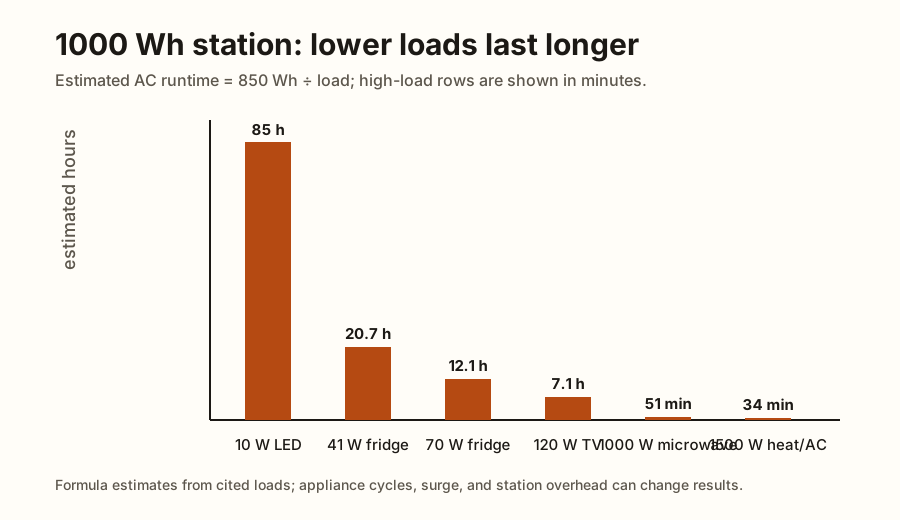
The hours below use 1000 Wh × 0.85, so 850 watt-hours of usable AC energy, unless noted. Change the capacity to the figure on your label (1024, 1056, 1070, or 1152 Wh) if you want a tighter estimate. These are not measurements of any appliance in our shop.
Refrigerator (the usual priority). This is covered in detail in How long will a power station run a refrigerator. In brief:
- A new ENERGY STAR certified top-freezer around 17–19 cubic feet with no ice maker has a median published annual use of 363 kWh in the official ENERGY STAR dataset we queried on 10 November 2026. That is 363 ÷ 8,760 × 1,000 ≈ 41 W on average, and 1000 × 0.85 ÷ 41 ≈ 21 hours.
- EIA’s 2020 Residential Energy Consumption Survey (Table CE5.3b, revised March 2024) puts the average US most-used refrigerator — including older machines still in homes — at 617 kWh/year, or about 70 W average: 1000 × 0.85 ÷ 70 ≈ 12 hours.
The inverter still has to absorb the starting surge (Honda’s 1,200 W estimate for an ENERGY STAR fridge or freezer). Leave headroom; do not start the fridge and a microwave in the same moment.
Lights. Use the wattage printed on the lamp or bulb. A 10 W LED used 8 hours takes 80 Wh at the lamp, or about 94 Wh from the battery at 85% inverter efficiency. Several LED lamps plus a fridge is a realistic overnight pair; incandescent bulbs waste the pack quickly.
Internet and phones. A typical home Wi-Fi router and a phone or two are low, often well under 20 W combined if you read the nameplates, and can last a day or more beside a fridge. Confirm the router’s label rather than assuming a marketing figure.
Television. Honda’s guide lists about 120 W for a 20-inch flat screen and 190 W for a 46-inch set. At 120 W, 1000 × 0.85 ÷ 120 ≈ 7 hours; at 190 W, about 4.5 hours. Annual EIA figures for TVs are not a good runtime input, because they already average in hours the set is off.
Laptop. Honda lists 200–250 W for a laptop, which is a generous planning number for many modern notebooks. If your charger’s label says 65 W, use 65 W: 1000 × 0.85 ÷ 65 ≈ 13 hours of charging time, not 13 hours of continuous heavy use if the pack is unplugged.
Microwave, kettle, coffee maker. These are short, high draws. Honda lists a 4-cup coffee maker at 600 W and a 1,000 W microwave at 1,500 starting and running watts in its home table (its 650 W microwave row is listed at 1,000 W). A 1,000 W microwave on a 1000 Wh pack at 85% efficiency is about 50 minutes of run time in total, not a full meal plan for the day. Use them in short bursts, and not at the same time as another heavy load.
CPAP and other medical devices. Plan from the device manual and talk to a clinician about backup. Some power stations advertise a fast AC transfer when used like a small UPS (Jackery’s 1000 v2 FAQ describes an automatic switch within 20 ms, and says this is not a 0 ms UPS for servers). That is a manufacturer claim, not a medical rating. Ready.gov advises households to plan specifically for power-dependent medical devices and refrigerated medicines.
Loads that usually do not fit a 1 kWh-class station
- Most window air conditioners. Honda’s 10,000 BTU example (2,200 W start, 1,500 W run) is already at or above this class’s continuous output, and starting surge is higher.
- Electric 240 V appliances — dryers, ranges, many water heaters and well pumps, some furnace blowers. Honda flags many of these as requiring 240 V. A 120 V station cannot feed them, and the wattage is too high anyway.
- Whole-house loads. These packs are for appliances plugged into the station, not for running a service panel, unless a qualified electrician has installed an approved transfer arrangement. More on that in the renters article.
- Portable generators used indoors. A battery station produces no engine exhaust. A gasoline generator does. The US Consumer Product Safety Commission warns that generator exhaust contains carbon monoxide and that generators must never be run inside a home, garage, basement, crawlspace, or shed.
A simple outage stack
A practical 1000Wh stack for a short outage is: the refrigerator (if the surge fits), LED lighting, a communications link (router or phone charging), and brief use of a kettle or microwave. Keep the freezer closed when you can. Ready.gov notes that a refrigerator keeps food cold for about four hours if it stays closed, and a full freezer about 48 hours — useful if you need to take the fridge off the battery for a while to run something else.
If you need the fridge for a multi-day outage, a 1 kWh pack alone is tight, especially on an older, hungrier machine. Solar input can extend the day if you have a safe place for panels and weather allows; published solar input limits on these four models range from 400 W (Jackery 1000 v2, dual port) to 500 W (DELTA 2 and AC180) to 600 W (SOLIX C1000). Those are input ceilings, not a guarantee of full sun.
How to use this without over-trusting a table
- Read the appliance nameplate (volts, watts or amps). Watts ≈ volts × amps for a simple AC load.
- Confirm the station’s continuous and surge AC ratings, and its voltage, from the manual for your region.
- Estimate hours with capacity × 0.85 ÷ average watts, or with the maker’s own formula if they publish one.
- Leave margin for surge, cold weather, and a battery that is not new.
For medical-device planning, see Sizing a power station for a CPAP overnight. For solar extension, see How much solar to recharge a power station in a day.
If you want the fridge case worked start to finish, continue to How long will a power station run a refrigerator. If you live in a rented flat or apartment, see Backup power for renters and apartments.
Sources
- ENERGY STAR Certified Residential Refrigerators dataset (p5st-her9), queried 10 November 2026. Product finder: certified residential refrigerators.
- US Energy Information Administration, 2020 RECS Table CE5.3b (revised March 2024), average electricity use for most-used refrigerators.
- Honda Power Equipment, What wattage generator do I need? (approximate starting and running watts).
- EcoFlow DELTA 2 US product page and DELTA 2 user manual (1024 Wh, 1800 W, 2700 W surge).
- Jackery Explorer 1000 V2 basic information (1070 Wh, 1500 W, 3000 W instantaneous; page updated 15 October 2026). Regional product pages: Canada, Australia.
- BLUETTI AC180 US product page (1152 Wh, 1800 W, 2700 W, and the published runtime formula).
- Anker SOLIX C1000 US product page (1056 Wh, 1800 W, SurgePad 2400 W).
- US Consumer Product Safety Commission, Portable Generator Hazards (Publication 5123).
- Ready.gov, Power outages (food holding times; medical-device planning; generator siting).
Try the estimate with your own numbers
For planning, a useful first estimate of how long a portable power station can run a load is:
Runtime (hours) ≈ battery capacity (Wh) × inverter efficiency ÷ load (W)
We use 0.85 as a conservative inverter-efficiency factor when a manufacturer does not publish one. That is a planning assumption, not a lab measurement. Some makers publish a similar figure: BLUETTI, for example, lists inverter efficiency of 85% for the AC180, and also subtracts depth of discharge and the station’s own standby draw.
Use this calculator for the simple form of the estimate. It runs in your browser and does not send any data.
This is not a test result. Real runtime also depends on depth of discharge, standby consumption, temperature, battery age, and whether the load cycles (a refrigerator) or runs continuously (a lamp). For surge versus running watts, see the article notes below: the inverter must cover the motor’s starting surge even if average watts look small.
Frequently asked questions
Will a 1000Wh power station run a refrigerator?
Often yes, if the inverter’s continuous and surge ratings cover the fridge’s running and starting watts. How long it lasts depends on the fridge’s average draw. A new ENERGY STAR top-freezer around 363 kWh/year averages about 41 W, so a 1000Wh pack at 85% inverter efficiency is a roughly 20-hour estimate. A typical in-service “most-used” refrigerator in the 2020 RECS used 617 kWh/year, about 70 W on average, closer to 12 hours. These are formula estimates, not lab tests.
Can it run a window air conditioner or a clothes dryer?
Usually not. Honda’s wattage guide lists a 10,000 BTU window air conditioner at about 2,200 starting watts and 1,500 running watts, and an electric clothes dryer at 6,750 starting watts and 5,400 running watts. Those running loads already meet or exceed the 1,500–1,800 W AC output of typical 1 kWh-class stations, and the dryer also needs 240 V.
Why isn’t a 1000Wh battery ten hours at 100 watts?
Inverter and conversion losses mean you cannot use every rated watt-hour at the AC outlet. A simple planning factor is 85% efficiency, so 1000 × 0.85 ÷ 100 = 8.5 hours. Some manufacturers also reserve a portion of the battery (depth of discharge) and subtract the station’s own standby draw.
Do US, UK, Australian, and Canadian models differ?
Yes. Capacity may be similar, but AC voltage and outlet type follow the local grid — typically 120 V in the US and Canada, and 230 V in the UK and Australia. Cite the product page and nameplate for the region where you will use the unit. A 120 V station will not directly power a 230 V appliance.