Guide
Backup Power for Renters and Apartments
How to plan apartment and rental backup power with a portable power station — indoor-safe batteries versus generators, no backfeeding, lease and balcony constraints, and a realistic essential-load list.
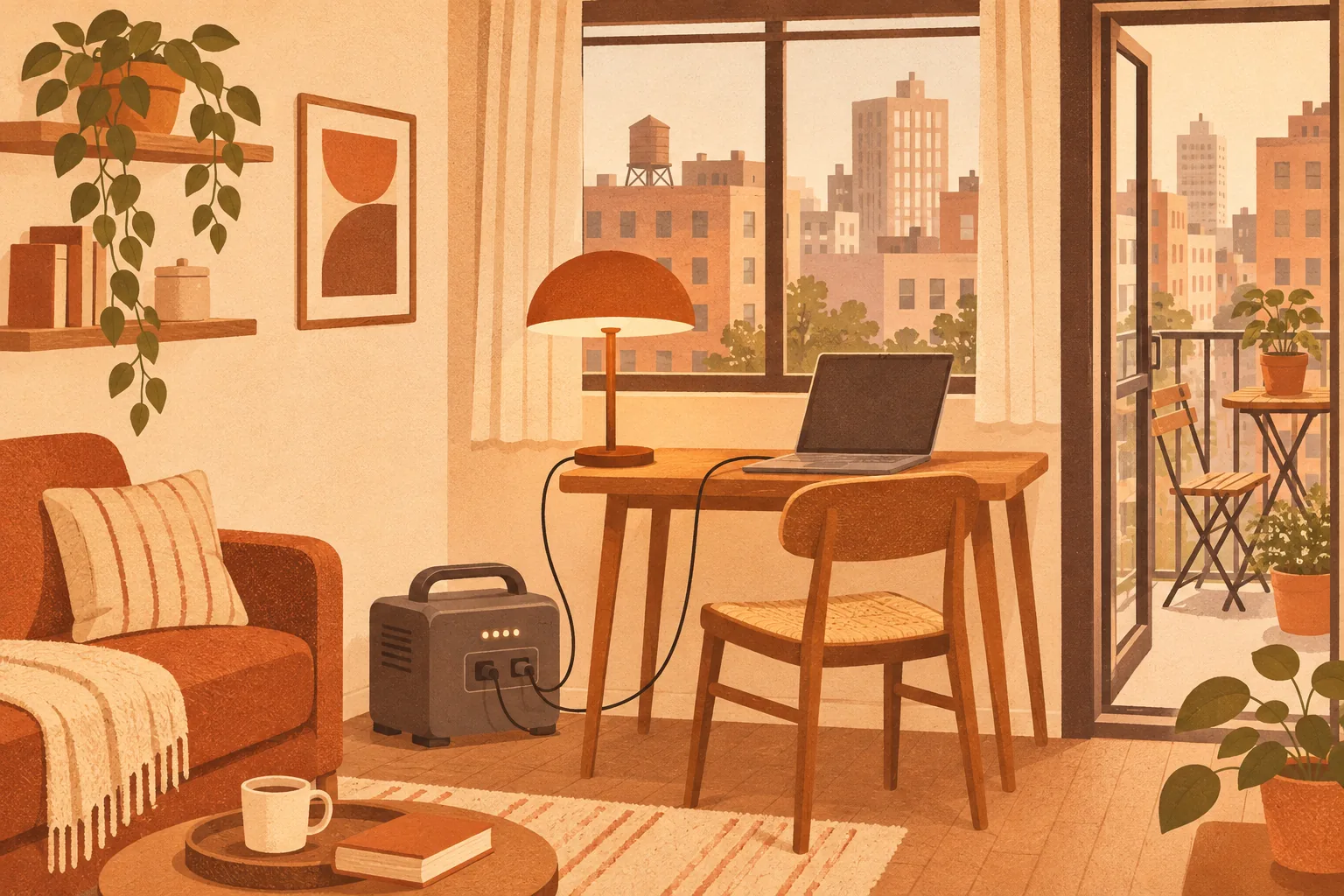
Renters have the same need to keep a fridge cold and a phone charged as anyone else, and fewer options for a built-in standby generator or a panel interlock. A portable power station — a battery with an inverter — is often the tool that actually fits a flat: it has no exhaust, it plugs into ordinary appliances, and the 1 kWh-class units described in our outage guide weigh roughly 11–16 kg (about 24–35 lb).
This is a constraints article, not a legal review and not a product test. Lease language, building codes, and electrical rules vary by country, state or province, and building. When a rule in the lease and a safety rule disagree, treat the safety rule as a floor, not a suggestion.
Why a battery is a different proposition from a generator in a flat
Engine-driven generators and battery stations are often sold in the same “backup power” aisle. They are not interchangeable in an apartment.
The US Consumer Product Safety Commission’s Portable Generator Hazards alert (Publication 5123) is blunt: using a generator indoors can kill you in minutes; exhaust contains carbon monoxide you cannot see or smell; never use a generator inside a home, garage, crawlspace, shed, or similar space, even with fans or open doors and windows. Ready.gov tells households to use a generator only outdoors and at least 20 feet from windows, doors, and attached garages, and to install carbon monoxide alarms.
In a high-rise or mid-rise, “20 feet from the building” is often not a balcony, a hallway, or a parking stall under an open window. Many leases also forbid fuel storage. A battery station does not solve every problem, but it does not produce generator exhaust, which is why it is the usual indoor-safe option for renters.
A battery still has rules of its own. Use the manufacturer’s temperature range, keep vents unobstructed, and keep the unit upright if the manual says so — BLUETTI’s AC180 FAQ, for example, says the unit should not be laid on its side. Do not block an egress path.
Do not backfeed the building
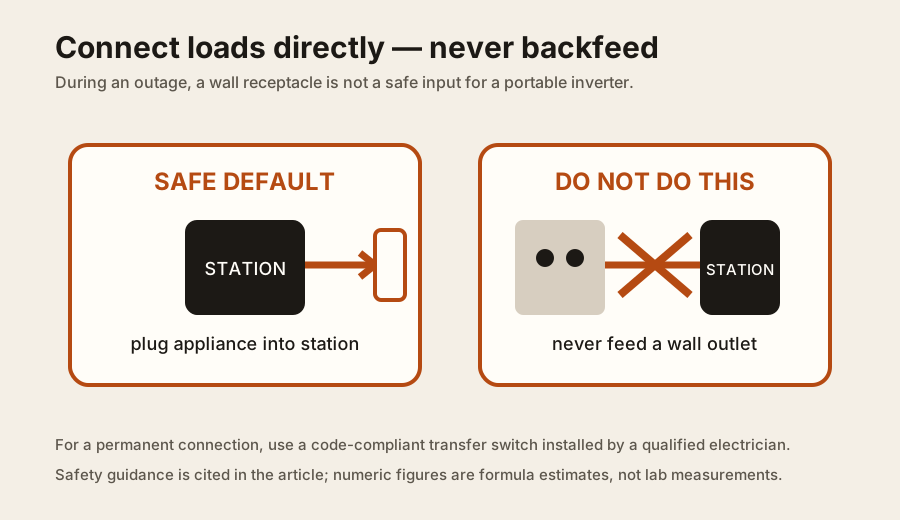
The CPSC also says: never try to power house wiring by plugging a generator into a wall outlet, a practice known as backfeeding. It “presents an electrocution risk to utility workers and neighbors served by the same utility transformer” and “bypasses some of the built-in household circuit protection devices.” Ready.gov’s guidance is to connect a generator to appliances with heavy-duty extension cords.
The same wiring hazard is present if you feed a receptacle from a battery inverter and hope the rest of the flat comes on. In a rental, you also have no standing to re-wire a shared service without the owner and a qualified electrician.
The safe default for a renter is simple: plug the appliances you care about into the power station (or into a properly rated extension cord from the station). Leave the wall outlets alone during the outage, except as a place to recharge the station when the grid is back, using the manufacturer’s AC charging cable.
If a more permanent hookup is ever appropriate, it requires a transfer switch or interlock installed to code, plus the landlord’s written permission. Most apartment backup plans will never get that far, and they do not need to if you only intend to run a fridge, lamps, and chargers.
What is realistic to keep up in a rented home
Start with a short list, not a whole-home wish.
Refrigerator. See How long will a power station run a refrigerator. For a 1000Wh-class station and a typical in-service US fridge (EIA 2020 most-used: 617 kWh/year, about 70 W average), the simple 0.85-efficiency estimate is around half a day. A newer, efficient top-freezer can stretch toward a day. Confirm that the station’s surge rating can start the compressor. Ready.gov’s food-safety figures still apply: about four hours of cold in a closed refrigerator, about 48 hours in a full freezer.
Lighting and communications. LED lamps and a modem or phone charger are small compared with a fridge and are the difference between an outage you can manage and one you cannot. Read the labels; do not assume.
Medical devices and medicines. Ready.gov asks people to plan with a medical provider for power-dependent devices and refrigerated medicines, and to know how long a medication can be held at a higher temperature. A transfer-time claim on a power station (some makers publish a figure such as 20 ms) is not a medical-device certification.
Cooking. A microwave or kettle may fit for short bursts if the continuous AC rating allows it. An electric range generally will not, and many are 240 V. Ready.gov warns against using a gas stove or oven to heat a home, because of carbon monoxide and fire risk.
Air conditioning. This is the painful gap in a small rented home. Honda’s guide lists a 10,000 BTU window air conditioner at approximately 2,200 starting watts and 1,500 running watts. That running load already sits at the ceiling of a 1,500–1,800 W inverter, and the surge is higher. A 1 kWh battery would also be empty in well under an hour at 1,500 W (1000 × 0.85 ÷ 1500 ≈ 0.6 hours). In extreme heat, Ready.gov advises going to a community location with power. A battery pack is not a substitute for that plan.
Heating. A small ceramic heater is often 1,500 W — the same short-runtime problem — and a 240 V furnace blower may be both too large and the wrong voltage (Honda flags many furnace fans as 240 V). Do not bring a generator or a charcoal grill indoors to stay warm.
Space, noise, and storage
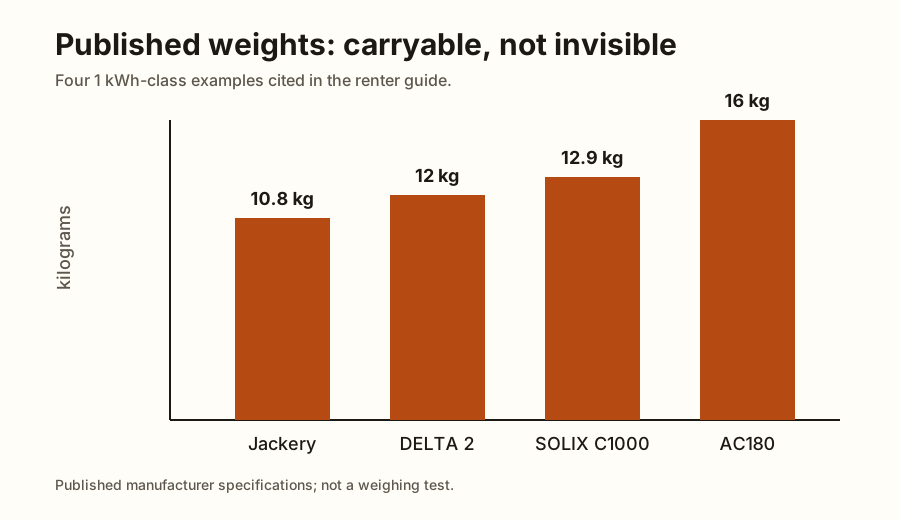
The four 1 kWh-class examples we cite publish weights of about 10.8 kg (Jackery Explorer 1000 v2), 12 kg (EcoFlow DELTA 2), 12.9 kg (Anker SOLIX C1000), and 16 kg (BLUETTI AC180). That is carryable, not invisible. Store the unit where it can be used without dragging it over a hallway trip hazard, and where the landlord’s rules on batteries and “appliances” allow.
Charging from the wall is the usual way to keep the pack ready. Published AC recharge times for these models are in the one-to-two-hour range at high input, but that is a manufacturer figure and it assumes a circuit that can supply the input watts (some list 1,000–1,440 W AC input). In an older building with a sensitive breaker, a slower charge mode — several makers offer one — may be the practical setting.
Solar input is attractive for a multi-day outage, and these models publish solar maxima of 400–600 W. A balcony or window setup has to respect the lease, not block a fire escape, and stay within the voltage and current window in the manual (for example, Jackery lists 16–60 V on the 1000 v2 DC inputs; BLUETTI lists 12–60 V and 500 W max for the AC180). It also only works in the sun. Treat solar as a way to stretch a carefully chosen load, not as a second utility.
Voltage and plugs if you are not on 120 V
This site’s primary published spec sheets for the models above are mostly North American 120 V pages. In the United Kingdom and Australia, household outlets are 230 V, and manufacturers often sell a regional SKU with a different inverter and plug. A 120 V station will not directly run a 230 V appliance. Use the manual and product page for the country you are in, and check the nameplate on both the station and the appliance.
The planning formula does not change: hours ≈ watt-hours × efficiency ÷ watts. The inverter limits and the plug do.
A renter’s checklist
- Keep a battery power station for indoor use; never run a fuel generator inside, or close to windows and vents.
- Plug appliances into the station. Do not backfeed a wall outlet.
- Size the pack from average watts for the fridge and from nameplate watts for everything else; check surge for the compressor.
- Write down any medical-device and medication needs before the outage, not during it.
- Confirm lease and building rules before you add balcony solar, store extra batteries, or ask for a hardwired transfer switch.
- Have a non-electrical backup for light and a plan for heat or dangerous temperatures that does not depend on a 1 kWh inverter.
For solar planning, see How much solar do you need to recharge a power station in a day. For CPAP planning, see Sizing a power station for a CPAP overnight.
This is general information, not advice about your lease, your wiring, or a particular medical device.
Sources
- US CPSC, Portable Generator Hazards, Publication 5123 (carbon monoxide; never use indoors; never backfeed a wall outlet).
- Ready.gov, Power outages (generator siting, extension cords, food holding times, medical devices, extreme heat or cold).
- Honda Power Equipment, Wattage estimation guide (window air conditioner and furnace-fan examples).
- US EIA, Table CE5.3b, 2020 RECS.
- Manufacturer specification pages used for weight, voltage, and solar input: EcoFlow DELTA 2, DELTA 2 manual, Jackery Explorer 1000 V2 basic information, BLUETTI AC180, Anker SOLIX C1000.
Try the estimate with your own numbers
For planning, a useful first estimate of how long a portable power station can run a load is:
Runtime (hours) ≈ battery capacity (Wh) × inverter efficiency ÷ load (W)
We use 0.85 as a conservative inverter-efficiency factor when a manufacturer does not publish one. That is a planning assumption, not a lab measurement. Some makers publish a similar figure: BLUETTI, for example, lists inverter efficiency of 85% for the AC180, and also subtracts depth of discharge and the station’s own standby draw.
Use this calculator for the simple form of the estimate. It runs in your browser and does not send any data.
This is not a test result. Real runtime also depends on depth of discharge, standby consumption, temperature, battery age, and whether the load cycles (a refrigerator) or runs continuously (a lamp). For surge versus running watts, see the article notes below: the inverter must cover the motor’s starting surge even if average watts look small.
Frequently asked questions
Can I use a portable power station indoors in an apartment?
A battery power station has no engine exhaust. A gasoline or propane generator does, and must not be used indoors. The US Consumer Product Safety Commission says never to run a portable generator inside a home, garage, basement, crawlspace, or shed, even with doors and windows open, because carbon monoxide can kill in minutes. Follow the battery maker’s manual for ventilation, temperature, and upright placement, and keep the unit where it will not block an exit.
Can I plug a power station into a wall outlet to power the whole flat?
No. Do not feed the building’s wiring through a wall receptacle. The CPSC calls that “backfeeding” when people do it with generators, and warns it can electrocute utility workers and neighbors and bypass household circuit protection. Plug appliances into the station, or have a qualified electrician install a proper transfer switch if your lease and the building allow a more permanent hookup — something many renters will not have.
Will a 1 kWh station run my window air conditioner?
Often no. Honda’s wattage guide lists a 10,000 BTU window air conditioner at about 2,200 starting watts and 1,500 running watts, which is at or above the 1,500–1,800 W continuous output of typical 1 kWh-class stations. Prioritize the refrigerator, lighting, communications, and any medical devices, and use a cooling centre if heat is dangerous, as Ready.gov advises.
Can I charge the station with a solar panel on a balcony?
Sometimes, if the lease, building rules, and safe access allow it, and if the panel’s voltage and current sit inside the station’s published solar-input range (for the 1 kWh-class models we cite, published maxima are 400–600 W). Do not obstruct fire escapes or walkways. Solar is weather-dependent and is an extender, not a guarantee of 24-hour power.