Guide
How Much Solar to Recharge a Power Station in a Day
A cautious way to estimate how much portable solar you need to refill a power station in a day, using NREL’s sun-hour definition, a station’s published solar-input cap, and PVWatts for your own location. Not a field test.
A power station that can run a fridge or a CPAP overnight is only half of a longer outage. The next question is whether portable solar can put a meaningful amount of energy back into the pack before sunset.
This article gives an upper-bound method you can take to NREL’s PVWatts calculator. It does not invent a table of city “peak sun hours,” and it is not a field test of any panel or any power station.
What a “sun-hour” is
The US National Renewable Energy Laboratory, in FY24OSTI-90210, describes peak irradiance as about 1 kW/m². A location’s daily kWh/m² is sometimes called a peak sun hour (or “sun-hour”). Four and a half sun-hours does not mean the sun shone for four and a half clock hours; it means the day’s energy on that surface was about the same as 4.5 hours at 1 kW/m².
The same NREL document uses a Colorado horizontal example of about 4.9 kWh/m²/day. That is a horizontal-surface example in the official text, not a forecast for a tilted portable panel on a balcony during an outage, and not a number for your city.
For your own plane-of-array estimate, use PVWatts. Set the location, tilt, and azimuth as close as you can to how you would actually place a portable panel, then read the solar-radiation or production figures in the results. Do not treat a fixed-roof average as a promise for a panel you will move twice in a day.
The optimistic upper bound
A simple first estimate, before extra derates, is:
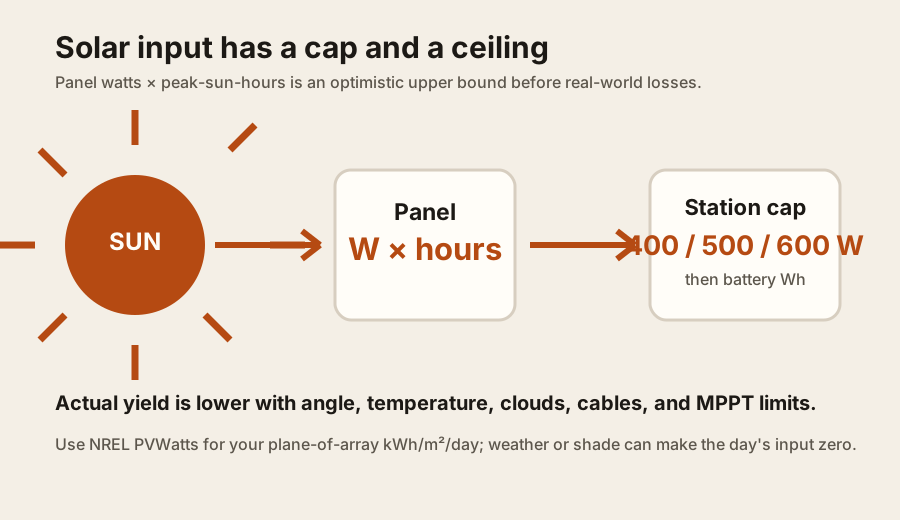
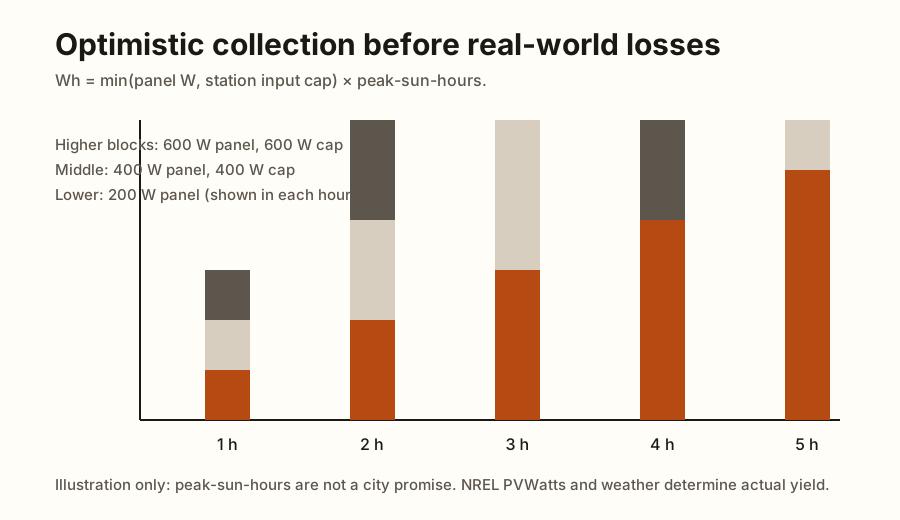
Daily watt-hours ≈ min(panel watts, station solar-input cap) × peak sun hours
Panel watts are the STC nameplate. The station cap is the published solar-input limit. Peak sun hours come from your PVWatts lookup or, for a worked illustration only, from NREL’s 4.9 Colorado horizontal example.
This is an optimistic upper bound. It ignores soiling, shade, poor tilt, temperature, cable loss, and the fact that a portable panel is rarely aimed as well as a modeled array. Real days are often lower.
Input caps on four 1 kWh-class stations
A 400 W or 600 W panel only helps if the station will accept that much. Manufacturer specifications for the models already cited on this site include these solar-input maxima:
| Station (regional page cited in our 1000Wh guide) | Published solar-input limit |
|---|---|
| Jackery Explorer 1000 v2 | 400 W |
| EcoFlow DELTA 2 | 500 W |
| BLUETTI AC180 | 500 W |
| Anker SOLIX C1000 | 600 W |
Voltage and current windows matter as much as watts. Published examples include a 16–60 V solar input window on the Jackery 1000 v2 materials and a 12–60 V window on the BLUETTI AC180. Crossing those limits is a hardware question, not something a watt-hour estimate can fix. Read the manual for your regional model.
Worked upper bounds
Using the formula above, with no extra derate:
| Peak sun hours | 200 W panel | 400 W panel or 400 W cap | 600 W panel at a 600 W cap |
|---|---|---|---|
| 2 | 400 Wh | 800 Wh | 1,200 Wh |
| 3 | 600 Wh | 1,200 Wh | 1,800 Wh |
| 4.9 (NREL Colorado horizontal example) | 980 Wh | 1,960 Wh | 2,940 Wh |
| 6 | 1,200 Wh | 2,400 Wh | 3,600 Wh |
On a 4.9 sun-hour day, a 400 W panel that the station can fully accept has an optimistic ceiling of about 1,960 Wh — enough, in this arithmetic, to refill a 1 kWh-class pack and have some left over. The same day with only 2 sun-hours and a 200 W panel is about 400 Wh, which does not refill the pack.
If the panel is 600 W but the station caps at 400 W, use 400 W in the formula, not 600 W. The extra nameplate does not pass the charge controller.
How this fits an outage day
A 1 kWh-class station that ran a refrigerator overnight, as in How long will a power station run a refrigerator, may start the morning already low. Solar can extend the outage only if you have a safe, legal place to set panels — a balcony or yard, not a street or a restricted roof — and only if the weather cooperates.
Do not count on solar to run a space heater or a window air conditioner. Those loads, as the high-load guide shows, can empty a 1 kWh pack in well under an hour.
A short method you can reuse
- Read the station’s solar-input watt, voltage, and current limits in the manual for your region.
- Look up a plane-of-array sun-hour or irradiance figure for your site in PVWatts.
- Compute an upper bound: min(panel watts, input cap) × sun hours.
- Treat the result as a ceiling, then leave generous margin for weather and placement.
- Confirm connectors and polarity; follow the manufacturer’s cable and combiner guidance.
Sources
- National Renewable Energy Laboratory, FY24OSTI-90210 (peak irradiance about 1 kW/m²; kWh/m² as a sun-hour; Colorado horizontal example about 4.9 kWh/m²/day).
- NREL, PVWatts Calculator.
- Jackery Explorer 1000 V2 basic information (400 W solar input; 16–60 V window as published in Jackery materials).
- EcoFlow DELTA 2 US product page (500 W solar input).
- BLUETTI AC180 US product page (500 W solar input; 12–60 V window as published).
- Anker SOLIX C1000 US product page (600 W solar input).
Try the estimate with your own numbers
For planning, a useful first estimate of how long a portable power station can run a load is:
Runtime (hours) ≈ battery capacity (Wh) × inverter efficiency ÷ load (W)
We use 0.85 as a conservative inverter-efficiency factor when a manufacturer does not publish one. That is a planning assumption, not a lab measurement. Some makers publish a similar figure: BLUETTI, for example, lists inverter efficiency of 85% for the AC180, and also subtracts depth of discharge and the station’s own standby draw.
Use this calculator for the simple form of the estimate. It runs in your browser and does not send any data.
This is not a test result. Real runtime also depends on depth of discharge, standby consumption, temperature, battery age, and whether the load cycles (a refrigerator) or runs continuously (a lamp). For surge versus running watts, see the article notes below: the inverter must cover the motor’s starting surge even if average watts look small.
Frequently asked questions
What is a peak sun hour?
NREL describes peak irradiance as about 1 kW per square meter, and a day’s kilowatt-hours per square meter is sometimes called a sun-hour. It is a solar-resource number for a location and a surface, not a clock hour of bright weather. Look up your own plane-of-array figure in NREL’s PVWatts rather than copying a city table we have not published.
How do I estimate watt-hours in a day?
An optimistic upper bound is daily Wh ≈ min(panel watts, the station’s solar-input limit) × peak sun hours. A 400 W panel in 4.9 sun-hours, if the station can accept 400 W, is at most about 1,960 Wh before other losses. Weather, angle, shade, temperature, and controller limits usually make the day lower.
Why does my panel’s rating not all go into the battery?
The station will not take more than its published solar-input cap. In the 1 kWh class we cite, that cap is 400 W on the Jackery Explorer 1000 v2, 500 W on the EcoFlow DELTA 2 and BLUETTI AC180, and 600 W on the Anker SOLIX C1000. Voltage and current must also stay inside the window in the manual.
Can I use a generic city sun-hour table?
We are not publishing one. City tables are easy to invent and hard to defend. NREL’s documentation gives a Colorado horizontal example of about 4.9 kWh/m²/day, which we use only as an illustration of the unit, not as a portable-panel forecast. Use PVWatts for your tilt, azimuth, and site.