Guide
How Long Will a Power Station Run a Refrigerator
Estimate refrigerator runtime from annual kWh, average watts, surge versus running watts, and a simple watt-hour formula — using ENERGY STAR, EIA, and manufacturer figures, not invented tests.
A refrigerator is usually the first appliance people want on a portable power station. It is also the easiest one to mis-estimate, because the number on a marketing “runtime” table, the number on the nameplate, and the number that actually drains the battery are often three different things.
This walk-through uses a public formula, the official ENERGY STAR certified-model dataset, and the US Energy Information Administration’s Residential Energy Consumption Survey. It is not a lab test of any fridge or any power station, and it does not use prices or star ratings.
The three wattages that get mixed up
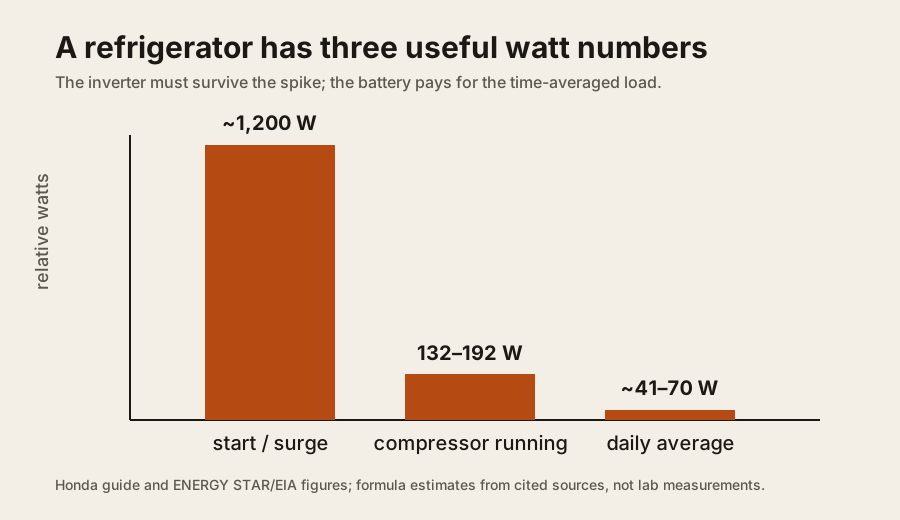
Starting (surge) watts are the short spike when the compressor motor starts. Honda’s wattage estimation guide lists an ENERGY STAR refrigerator or freezer at approximately 1,200 W to start and 132–192 W to run. The starting figure is what the inverter must survive. If it cannot, the station may click off at the moment the compressor kicks in.
Running watts are the draw while the compressor is actually on. They tell you whether the station’s continuous AC output is enough. Every 1 kWh-class station cited in our 1000Wh outage guide publishes a continuous output of 1,500–1,800 W, which is well above Honda’s 132–192 W running range — so the usual bottleneck for those models is surge and energy, not continuous watts.
Average watts over hours or days set the runtime. A fridge cycles. Over a year, ENERGY STAR and EIA publish annual kilowatt-hours, which already include that cycling. Convert with:
Average watts ≈ (kWh per year ÷ 8,760 hours) × 1,000
8,760 is the number of hours in a non-leap year, the usual conversion.
Two official pictures of “a refrigerator”
New certified models and the stock of machines actually in homes are not the same.
New ENERGY STAR certified models
We queried the official ENERGY STAR Certified Residential Refrigerators dataset on 10 November 2026 (4,930 certified models). Annual energy use is the tested figure EPA publishes for each model.
| Group in the official dataset | Models | Median annual use | ≈ average watts |
|---|---|---|---|
| Full-size (not compact) | 3,029 | 457 kWh/year | 52 W |
| Top-freezer, 17–19 cu ft, no ice maker | 280 | 363 kWh/year | 41 W |
| Bottom-freezer, 20–23 cu ft, with ice maker | 315 | 588 kWh/year | 67 W |
| Full-size side-by-side (all sizes in the set) | 128 | 641.5 kWh/year | 73 W |
| Compact (median capacity 3.3 cu ft) | 1,901 | 244 kWh/year | 28 W |
The 17–19 cu ft top-freezer group has a median capacity of 18.1 cubic feet. That is consistent with the US Department of Energy’s Federal Energy Management Program example, which cites 363.5 kWh/year for an ENERGY STAR 18.1 cu ft top-freezer with automatic defrost (guidance updated December 2023).
These medians are for certified models on the market, not a census of what people already own. Older refrigerators can use substantially more; ENERGY STAR certification is a threshold, not a description of the installed base.
Refrigerators actually in US homes (EIA)
The EIA’s 2020 Residential Energy Consumption Survey, Table CE5.3b (revised March 2024), estimates average site electricity use per household that has the end use:
| End use (2020 RECS) | kWh/year | ≈ average watts |
|---|---|---|
| Most-used refrigerator | 617 | 70 W |
| Second refrigerator | 494 | 56 W |
| Separate freezer | 570 | 65 W |
| All refrigerators in the home (combined) | 839 | — |
The “all refrigerators” row is a household total, not a single appliance, so do not put 839 kWh into the runtime formula unless you really are backing up every fridge at once.
EIA also notes, in its explainer on electricity use in homes, that 99% of US homes had a refrigerator in 2020 and 34% had two or more. The most-used refrigerator cost about $87 to run that year; we use the kWh figure from Table CE5.3b rather than converting that dollar amount back, because the table is the direct quantity.
The gap between ~41–52 W (new ENERGY STAR examples) and ~70 W (typical most-used fridge in 2020) is the main reason two honest estimates can differ by a third. If you know your model’s EnergyGuide kWh, use that. If you do not, the EIA 70 W average is the more conservative planning number for an unknown machine already in the kitchen.
Put the numbers through the formula
Runtime (hours) ≈ battery capacity (Wh) × 0.85 ÷ average watts
The 0.85 factor is a planning assumption for inverter and conversion losses. BLUETTI publishes 85% inverter efficiency for the AC180, and also applies a 90% depth of discharge and about 15 W of self-consumption. If you want to be stricter than the simple formula, use the maker’s version.
Worked examples, using the simple formula:
| Battery | Load basis | Average watts | Estimated hours |
|---|---|---|---|
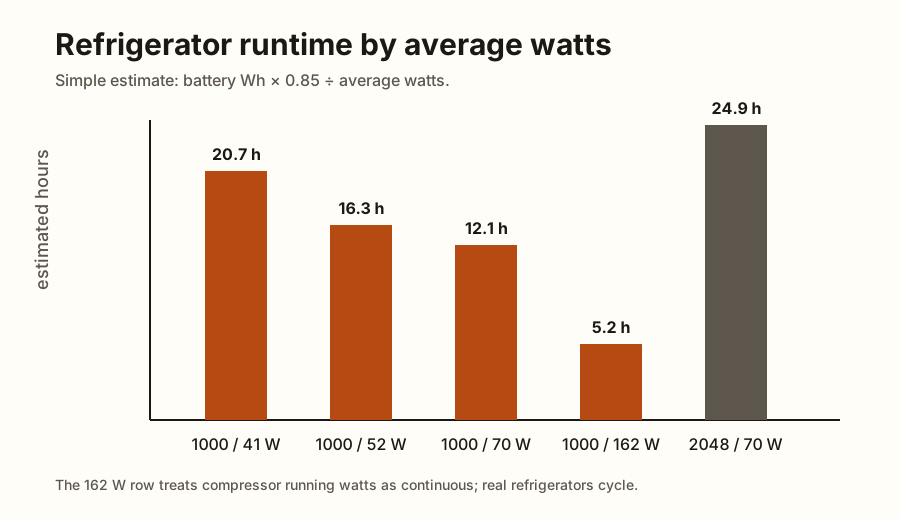
| 1000 Wh | ENERGY STAR 17–19 cu ft top-freezer, no ice maker (363 kWh/yr) | 41 W | 21 hours |
| 1000 Wh | ENERGY STAR full-size median (457 kWh/yr) | 52 W | 16 hours |
| 1000 Wh | EIA most-used refrigerator (617 kWh/yr) | 70 W | 12 hours |
| 1000 Wh | Honda running watts, mid-range, compressor held on | 162 W | 5.2 hours |
| 1024 Wh (DELTA 2 published capacity) | EIA 70 W | 70 W | 12 hours |
| 2048 Wh (two 1024 Wh, as an example) | EIA 70 W | 70 W | 25 hours |
Hours are rounded to the nearest hour except the “compressor held on” row, which shows what happens if you wrongly treat running watts as a 24-hour load. In a real kitchen the compressor cycles, so the ENERGY STAR and EIA rows are the better duration estimates — provided the inverter can handle each start.
Why a 120 W “fridge” row is a different claim
Manufacturer pages often show a refrigerator runtime that looks shorter than the EIA/ENERGY STAR math. EcoFlow’s DELTA 2 US page lists a refrigerator example at 120 W and 7–14 hours. 1024 × 0.85 ÷ 120 ≈ 7.3 hours, which matches the low end of that range if they are applying a similar efficiency factor and perhaps a duty-cycle band for the high end. Anker’s SOLIX C1000 page lists a “Refrigerator, 14 hrs” example without stating the assumed watts in the same summary.
Those rows are not wrong so much as underspecified. 120 W is closer to a running-watt or high-duty-cycle assumption than to a 41–70 W average from annual kWh. When a brand does not state the load, you cannot audit the hours. Prefer a calculation you can reproduce from a kWh figure on your EnergyGuide label.
BLUETTI also notes, under its AC180 runtime FAQ, that the published formula is “NOT suitable for inductive loads with compressors, like refrigerators,” and that the blender example is for reference only. That is a fair caution: a compressor’s start-up, defrost heaters, and door openings all move the result. The formula is still the right planning tool; it is not a stopwatch.
What changes the estimate in a real outage
- Door openings and a warm kitchen. Annual kWh is measured under a standard test (DOE 10 CFR 430, Subpart B, Appendix A, as cited by FEMP). A crowded, warm apartment during a summer outage will be harder on the battery than the test condition.
- Ice makers and through-the-door dispensers. In the ENERGY STAR set, adding an ice maker is associated with higher annual kWh (the 17–19 cu ft top-freezer median moves from 363 kWh without an ice maker to 450 kWh with one). FEMP likewise advises that through-the-door ice typically uses more energy.
- A second fridge or a garage unit. EIA’s second-refrigerator average is 494 kWh/year. If both must stay up, add the average watts and size the battery for the sum — and for two starting surges, preferably not at the same moment.
- Keep the doors closed when you can. Ready.gov says a refrigerator will keep food cold for about four hours if it stays closed, and a full freezer about 48 hours. That is about food safety, not battery math, but it means you can sometimes let the fridge ride without power for a stretch.
- Do not backfeed the building. Plug the fridge into the station (or a properly rated extension cord), or use a transfer switch installed by a qualified electrician. The US Consumer Product Safety Commission warns never to power house wiring by plugging a generator into a wall outlet (“backfeeding”). The same electrical hazard applies if you try to feed a panel from a battery inverter that way.
A short method you can reuse
- Find annual kWh on the EnergyGuide label, in the ENERGY STAR product finder, or, if the fridge is unknown, start from EIA’s 617 kWh/year most-used figure.
- Convert to average watts: kWh ÷ 8,760 × 1,000.
- Estimate hours: battery Wh × 0.85 ÷ average watts (or the manufacturer’s formula).
- Check starting and running watts against the station’s surge and continuous AC ratings, and against the voltage in your country.
- Leave margin for heat, age, and defrost cycles.
For the apartment safety constraints, see Backup power for renters and apartments. For the high-load contrast, see Can a power station run a window AC or space heater?.
Related: What can a 1000Wh power station run during an outage, and backup power for renters and apartments.
Sources
- ENERGY STAR Certified Residential Refrigerators dataset (p5st-her9), queried 10 November 2026; product finder.
- US EIA, Table CE5.3b, 2020 RECS (revised March 2024); Electricity use in homes.
- US Department of Energy FEMP, Purchasing energy-efficient residential refrigerators (18.1 cu ft top-freezer example, updated December 2023).
- Honda Power Equipment, Wattage estimation guide.
- EcoFlow DELTA 2 US product page (120 W / 7–14 hour refrigerator example; 1024 Wh).
- BLUETTI AC180 US product page (runtime formula and compressor caveat).
- Anker SOLIX C1000 US product page.
- US CPSC, Portable Generator Hazards, Publication 5123.
- Ready.gov, Power outages.
Try the estimate with your own numbers
For planning, a useful first estimate of how long a portable power station can run a load is:
Runtime (hours) ≈ battery capacity (Wh) × inverter efficiency ÷ load (W)
We use 0.85 as a conservative inverter-efficiency factor when a manufacturer does not publish one. That is a planning assumption, not a lab measurement. Some makers publish a similar figure: BLUETTI, for example, lists inverter efficiency of 85% for the AC180, and also subtracts depth of discharge and the station’s own standby draw.
Use this calculator for the simple form of the estimate. It runs in your browser and does not send any data.
This is not a test result. Real runtime also depends on depth of discharge, standby consumption, temperature, battery age, and whether the load cycles (a refrigerator) or runs continuously (a lamp). For surge versus running watts, see the article notes below: the inverter must cover the motor’s starting surge even if average watts look small.
Frequently asked questions
How many watts does a refrigerator use?
There are three different “watts” to keep straight. Starting (surge) watts can be around 1,200 W on Honda’s ENERGY STAR fridge or freezer estimate. Running watts while the compressor is on are listed there at 132–192 W. Average watts over a day are much lower because the compressor cycles: a new ENERGY STAR 17–19 cu ft top-freezer with no ice maker (median 363 kWh/year in the official dataset) averages about 41 W. The average most-used refrigerator in EIA’s 2020 survey used 617 kWh/year, about 70 W.
How long will a 1000Wh station run my fridge?
Using runtime ≈ Wh × 0.85 ÷ average watts, a 1000Wh station is about 21 hours for a 41 W ENERGY STAR top-freezer estimate, and about 12 hours for a 70 W EIA most-used refrigerator estimate. Double the battery, and those hours roughly double, if the inverter can still start the compressor.
Why do manufacturer websites show a different fridge runtime?
Marketing tables often assume a single round-number load, such as 120 W, and a duty cycle that is not always spelled out. EcoFlow’s DELTA 2 page, for example, shows a refrigerator row at 120 W and 7–14 hours. That 120 W is not the same as the 41–70 W average from ENERGY STAR or EIA annual figures. If you do not know the assumed load, you cannot compare the hours.
Will a power station start my refrigerator?
Only if its surge rating exceeds the compressor’s starting draw and its continuous rating exceeds running watts. Honda’s 1,200 W starting estimate for an ENERGY STAR fridge is within the published surge figures of the 1 kWh-class stations we cite (2,400–3,000 W), but an older or larger compressor can demand more. If the station trips when the compressor kicks on, the pack still has energy — the inverter just cannot cover the spike.