Guide
Can a Power Station Run a Window AC or a Space Heater?
Why a 1 kWh-class power station can fail a window air conditioner or space heater in two different ways — inverter surge and continuous limits, and battery energy that lasts only minutes. Honda published wattages and a simple runtime formula, not a lab test.
People often buy a portable power station with a quiet hope that it will also run the window air conditioner or the space heater. Those two loads fail a 1 kWh-class pack in different ways, and it helps to separate them.
This article uses Honda’s published wattage estimates, ordinary nameplate examples, and the same runtime formula as the rest of this site. It is not a laboratory test of any heater, any window unit, or any power station.
Two limits, not one
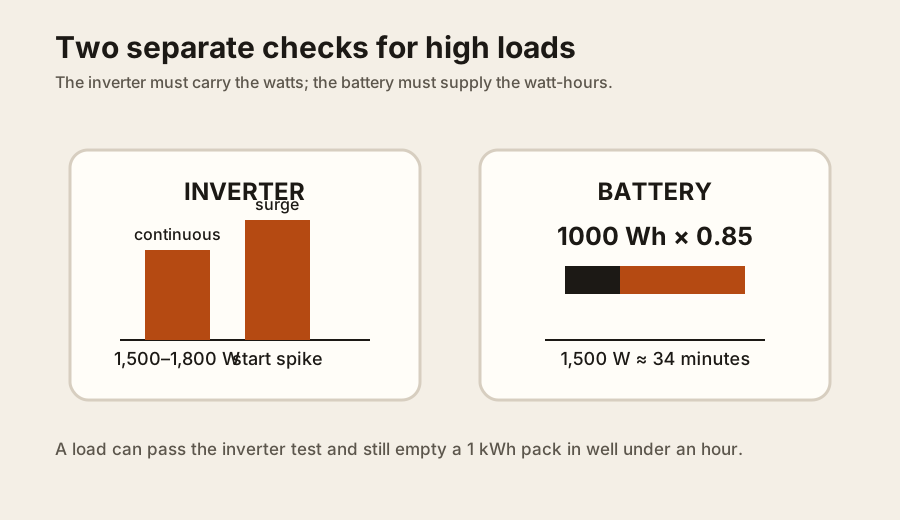
The inverter limit is whether the station can start the load and carry it. Starting (surge) watts must fit the inverter’s surge rating. Running watts must fit its continuous AC rating.
The energy limit is how long the battery lasts once the load is actually running:
Hours ≈ battery Wh × 0.85 ÷ running watts
A pack can pass the first test and still fail the second in minutes.
Window air conditioners
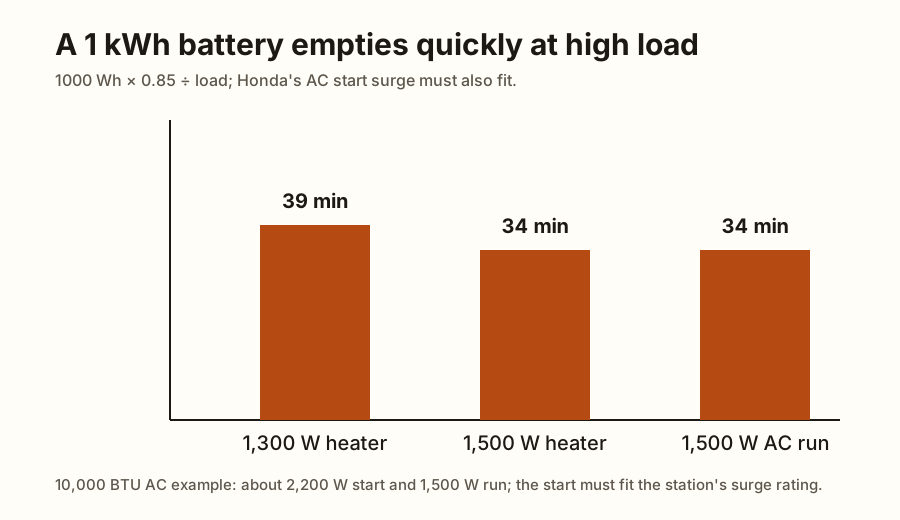
Honda’s wattage estimation guide lists a 10,000 BTU window air conditioner at approximately 2,200 W to start and 1,500 W to run.
On the 1 kWh-class stations described in our outage guide:
- Continuous AC output is 1,500–1,800 W. A 1,500 W running load is at the cap of a 1,500 W inverter (the Jackery Explorer 1000 v2’s published continuous rating) and near the cap of an 1,800 W inverter.
- Surge ratings in that class are 2,400–3,000 W. Honda’s 2,200 W start fits some of those figures with little margin, and a different unit can demand more.
Even if both electrical limits are met, energy is short:
1000 × 0.85 ÷ 1,500 ≈ 0.57 hours, about 34 minutes.
A window AC also cycles, so a real hour may use less than 1,500 W on average — but we do not have a sourced duty cycle to turn that into a longer official estimate, and starting spikes still happen each time the compressor kicks on. Do not plan a hot afternoon around a number we have not sourced.
Space heaters
Honda’s recreational-wattage table lists a radiant heater at 1,300 W starting and 1,300 W running. That is a published Honda figure, and it is the heater wattage we attribute to Honda in this article.
Many household space heaters are sold as 1,500 W nameplate devices. We treat 1,500 W as a common nameplate, not as a Honda listing.
Formula runtimes from a 1000 Wh pack at a 0.85 factor:
| Load | Running watts | Estimated runtime |
|---|---|---|
| Honda radiant heater | 1,300 W | ≈ 0.65 h (about 39 minutes) |
| 1,500 W nameplate heater, or Honda’s 10,000 BTU window AC running watts | 1,500 W | ≈ 0.57 h (about 34 minutes) |
| EIA most-used refrigerator, for scale | 70 W average | ≈ 12 hours |
A 1,300 W radiant heater is a continuous load once it is on, so the inverter only has to cover 1,300 W — within a 1,500–1,800 W continuous rating — and there is no large compressor surge in Honda’s 1,300 / 1,300 listing. The pack still empties in well under an hour.
What to prioritize instead
For a short outage, the loads that make sense on a 1 kWh-class station are the ones that last for hours: the refrigerator, LED lighting, phone and router charging, and, where clinically appropriate, a CPAP. Official guidance from Ready.gov is about food safety, medical devices, and staying safe in heat or cold — not about treating a luggage-sized battery as a heating appliance.
If you do try a heater or a window unit, read both nameplates, confirm the station’s continuous and surge ratings for your regional voltage, and expect minutes, not an evening.
Solar input will not change that arithmetic much in a single hour. Even a strong sun-hour, as discussed in How much solar to recharge a power station in a day, adds hundreds of watt-hours, not the many kilowatt-hours a 1,500 W heater would need to run all afternoon.
Sources
- Honda Power Equipment, Wattage estimation guide (10,000 BTU window AC, about 2,200 W start and 1,500 W run; radiant heater, 1,300 W start and run).
- US EIA, 2020 RECS Table CE5.3b (most-used refrigerator, 617 kWh/year, about 70 W, used here only as a scale comparison).
- Jackery Explorer 1000 V2 basic information (1,500 W continuous, 3,000 W instantaneous).
- EcoFlow DELTA 2 US product page (1,800 W continuous, 2,700 W surge).
- BLUETTI AC180 US product page (1,800 W continuous, 2,700 W surge).
- Anker SOLIX C1000 US product page (1,800 W continuous, 2,400 W SurgePad).
- Ready.gov, Power outages.
Try the estimate with your own numbers
For planning, a useful first estimate of how long a portable power station can run a load is:
Runtime (hours) ≈ battery capacity (Wh) × inverter efficiency ÷ load (W)
We use 0.85 as a conservative inverter-efficiency factor when a manufacturer does not publish one. That is a planning assumption, not a lab measurement. Some makers publish a similar figure: BLUETTI, for example, lists inverter efficiency of 85% for the AC180, and also subtracts depth of discharge and the station’s own standby draw.
Use this calculator for the simple form of the estimate. It runs in your browser and does not send any data.
This is not a test result. Real runtime also depends on depth of discharge, standby consumption, temperature, battery age, and whether the load cycles (a refrigerator) or runs continuously (a lamp). For surge versus running watts, see the article notes below: the inverter must cover the motor’s starting surge even if average watts look small.
Frequently asked questions
Can a 1000Wh power station run a space heater?
Only briefly, and only if the inverter can carry the running watts. A 1,500 W nameplate heater on a 1000 Wh pack at a 0.85 planning factor is about 34 minutes. Honda’s wattage guide lists a radiant heater at 1,300 W starting and running; that estimate is about 39 minutes. These are formula hours, not a test, and they assume the heater actually stays at that draw.
Can it run a window air conditioner?
Often the inverter is the first problem. Honda’s 10,000 BTU window-unit example is 2,200 W to start and 1,500 W to run. A station with a 1,500 W continuous rating is already at its cap on the running load, and the 2,200 W start must fit the surge rating. Even if both clear, 1000 × 0.85 ÷ 1,500 is only about 34 minutes of energy.
Why is this so different from a refrigerator?
A fridge’s all-day average is tens of watts because the compressor cycles. A heater or a window AC, when it is actually heating or cooling, is a high continuous load. The same 1000 Wh pack that is about 12 hours on a 70 W EIA fridge average is well under an hour on 1,300–1,500 W.
Should I prioritize heat or cooling on a small battery?
Usually no. For a short outage, lighting, communications, medical devices, and the refrigerator are the loads a 1 kWh-class pack can cover for hours rather than minutes. Use clothing, blankets, a cooler room, and official heat- or cold-weather guidance rather than treating the battery as a heating plan.