Guide
Sizing a Power Station for a CPAP Overnight
Worked estimates for an overnight CPAP backup using ResMed’s published AirSense 11 wattages, a simple watt-hour formula, and the limits of a 500–1000 Wh portable power station. Not medical advice and not a lab test.
If you use a CPAP, an outage is not only inconvenient. You want a clear idea of whether a portable power station can cover a night, and you want that idea to come from the device maker’s published watts, not from a round number on a marketing table.
This article works the arithmetic for one documented example, ResMed’s AirSense 11, then shows how to repeat the method from your own manual. It is not medical advice, not a recommendation of any machine, and not a laboratory test of a CPAP or a power station.
Start with the published watts, not a guess
ResMed’s AirSense 11 Americas user guide lists, for the 65 W power supply unit used in that region:
- Typical power consumption: 56.1 W
- Peak power consumption: 73.2 W
Those are the only AirSense 11 wattages used in this article. We do not invent a lower “without humidifier” number, because that figure is not in the pages we cited.
Your machine may differ. Humidifiers, heated tubes, altitude, and the pressure your clinician set all change the draw. If your manual or a clinician-supplied specification lists different watts, use those.
ResMed also sells an official Air11 DC/DC converter accessory for vehicle or specified DC supplies. That is a manufacturer accessory, not a reason to assume any generic DC socket is approved. Follow the manual for the input your machine is certified to use.
Energy for an eight-hour night
A planning night of eight hours at the published typical wattage is:
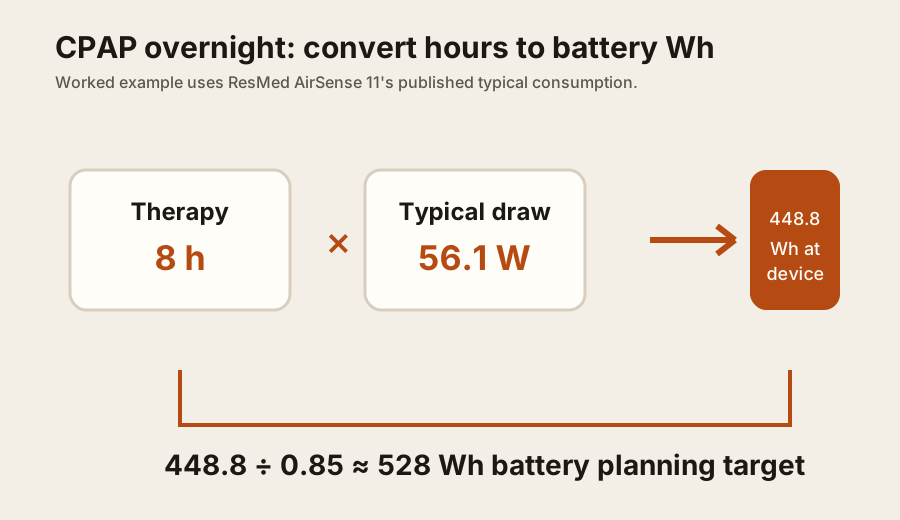
8 × 56.1 W = 448.8 Wh at the device.
A first estimate of the battery you need, using the same 0.85 planning factor as the rest of this site, is:
448.8 ÷ 0.85 ≈ 528 Wh of battery capacity.
That 0.85 is a planning assumption for inverter and conversion loss, not a measurement of one station. If a maker publishes its own formula, prefer that version.
What 500 Wh and 1000 Wh packs imply
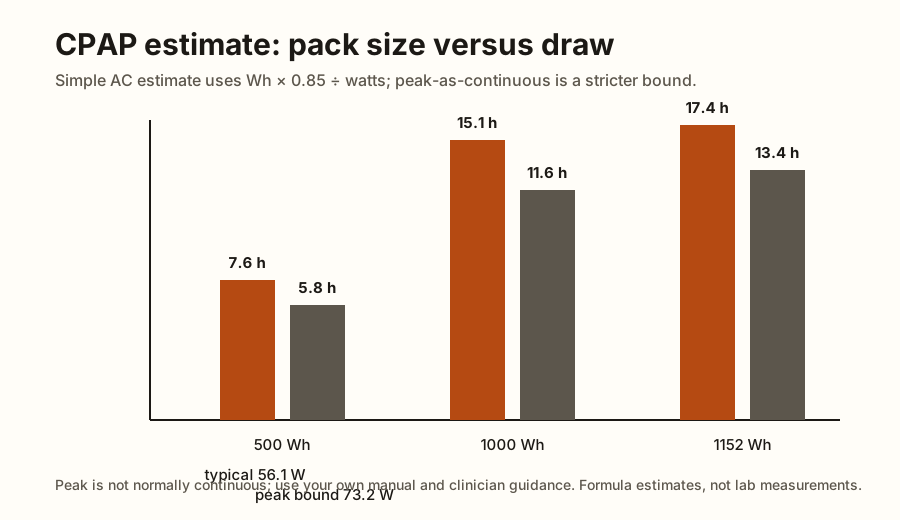
Using hours ≈ battery Wh × 0.85 ÷ load watts:
| Pack (nameplate Wh) | At 56.1 W typical | At 73.2 W peak (stricter bound) |
|---|---|---|
| 500 Wh | ≈ 7.6 hours | ≈ 5.8 hours |
| 1000 Wh | ≈ 15.2 hours | ≈ 11.6 hours |
| 1152 Wh (BLUETTI AC180 capacity) | ≈ 17.4 hours | ≈ 13.4 hours |
A 500 Wh pack at the typical figure is tight for a full eight-hour night. A 1000 Wh-class pack has comfortable margin in this arithmetic, still as an estimate.
The peak column is not “what the machine draws all night.” It is a stricter bound if you plan as though the published peak were continuous. Reality will usually sit between the two, and only a measurement of your setup would tell you where.
A stricter formula, if you want more conservatism
Some manufacturers publish a fuller expression. BLUETTI’s AC180 materials, for example, describe runtime with a depth-of-discharge factor and note that the inverter itself consumes power. As a worked illustration only, if you take 1000 Wh, a 0.90 depth-of-discharge factor, a 0.85 inverter factor, a 56.1 W load, and a 15 W allowance for the station’s own draw:
1000 × 0.90 × 0.85 ÷ (56.1 + 15) ≈ 10.8 hours
That is still a formula, not a test, and 15 W is a planning allowance we already use on this site, not a measured standby figure for a particular night. The simpler 15-hour estimate above is more optimistic because it ignores those two terms. If your station’s manual gives a self-consumption or DoD figure, use that.
Starting, transfer time, and what we are not claiming
A CPAP is usually a modest continuous load compared with a refrigerator compressor or a space heater. The 65 W supply, and the 73.2 W peak in the AirSense 11 guide, sit far below the 1,500–1,800 W continuous AC ratings of the 1 kWh-class stations described in What can a 1000Wh power station run during an outage. The usual question is energy for the night, not whether the inverter can carry the running load.
Two caveats still matter:
- Transfer time is not a medical UPS rating. Some power-station makers advertise an automatic switch to battery in tens of milliseconds when the unit is already plugged in like a small UPS. That is a manufacturer claim. It does not make the pack a certified medical backup.
- ResMed documents that therapy can restart after a power interruption. That is also a manufacturer statement about the device’s behavior, not a guarantee that every outage, every station, and every clinical need is covered.
Plan backup power with your clinician, especially if you depend on the therapy. Keep the station charged. If you travel, confirm voltage and plug type for the regional model of both the CPAP supply and the station.
For the wider outage stack, see the 1000Wh outage guide. For charging the pack again the next day, see How much solar to recharge a power station in a day.
Sources
- ResMed, AirSense 11 Americas user guide (65 W PSU; typical 56.1 W, peak 73.2 W).
- ResMed, Air11 DC/DC converter accessory information on the company’s support and accessory pages (official DC accessory; follow the manual).
- BLUETTI AC180 US product page (published runtime formula; 1152 Wh capacity).
- Jackery Explorer 1000 V2 basic information (example of a manufacturer transfer-time claim; not a medical rating).
- Ready.gov, Power outages (plan with a medical provider for power-dependent devices).
Try the estimate with your own numbers
For planning, a useful first estimate of how long a portable power station can run a load is:
Runtime (hours) ≈ battery capacity (Wh) × inverter efficiency ÷ load (W)
We use 0.85 as a conservative inverter-efficiency factor when a manufacturer does not publish one. That is a planning assumption, not a lab measurement. Some makers publish a similar figure: BLUETTI, for example, lists inverter efficiency of 85% for the AC180, and also subtracts depth of discharge and the station’s own standby draw.
Use this calculator for the simple form of the estimate. It runs in your browser and does not send any data.
This is not a test result. Real runtime also depends on depth of discharge, standby consumption, temperature, battery age, and whether the load cycles (a refrigerator) or runs continuously (a lamp). For surge versus running watts, see the article notes below: the inverter must cover the motor’s starting surge even if average watts look small.
Frequently asked questions
How many watts does a CPAP use?
It depends on the machine, the pressure setting, and accessories such as a humidifier and heated tube. For one widely used example, ResMed’s AirSense 11 Americas user guide lists typical power consumption of 56.1 W and peak power consumption of 73.2 W with the official 65 W power supply. Use the figures in your own manual rather than assuming a lower number we have not sourced.
Will a 500 Wh power station last a full night?
At ResMed’s published typical 56.1 W and a 0.85 planning factor, a 500 Wh pack is about 7.6 hours, which is tight for an eight-hour night. The same formula at the 73.2 W peak figure is about 5.8 hours. A 1000 Wh-class station is about 15 hours at 56.1 W, or about 11.6 hours at 73.2 W. These are formula estimates, not measurements of any machine.
How large a battery do I need for eight hours?
Eight hours at 56.1 W is about 449 Wh at the device. Dividing by a 0.85 planning factor gives about 528 Wh of battery capacity as a first estimate. Leave margin for a higher overnight setting, a humidifier, inverter losses that may be worse than 0.85, and the station’s own idle draw.
Can I use a power station as a medical UPS?
Not on the strength of a marketing transfer-time claim. Some makers say the AC outlet can switch to battery in tens of milliseconds, and ResMed documents that AirSense 11 can restart therapy after a power interruption. Those are manufacturer statements, not a medical-device UPS rating. This article is not medical advice; plan backup with your clinician.