Guide
How Many Watts Does a Furnace Blower Need?
Honda’s 1/3 hp furnace-fan example needs 1,400 W to start and 700 W to run, with a 240 V flag. A compatible 1000 Wh supply estimates to 1.2 hours at that running load, not a whole-furnace test.
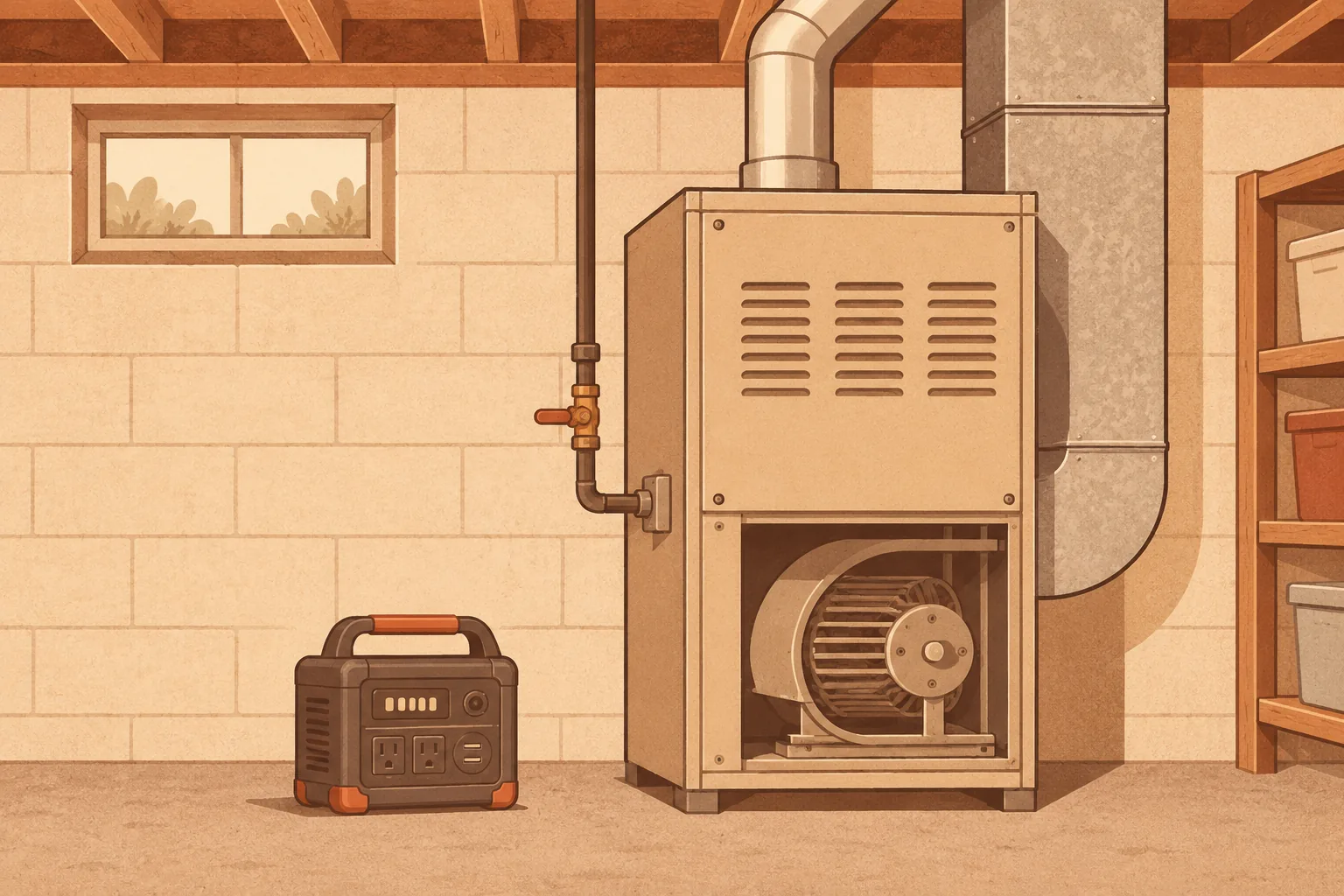
For a 1/3 hp gas- or fuel-oil furnace fan, Honda’s wattage guide estimates 1,400 W to start and 700 W to run, and marks the example 240 V required. A 120 V power station cannot directly run that 240 V load, even if its wattage rating exceeds the fan’s demand.
For a supply that does match the blower, hours ≈ battery Wh × 0.85 ÷ running W, so 1000 × 0.85 ÷ 700 ≈ 1.21 hours, or about 1.2 hours of continuous blower operation. The 0.85 factor is an assumption, not a measured efficiency. The 1000 Wh capacity is a worked example, not a claim about every station sold in that class.
We have not tested a furnace blower on a power station. This is a calculation from Honda’s estimates, not a test of your heating system or a wiring plan.
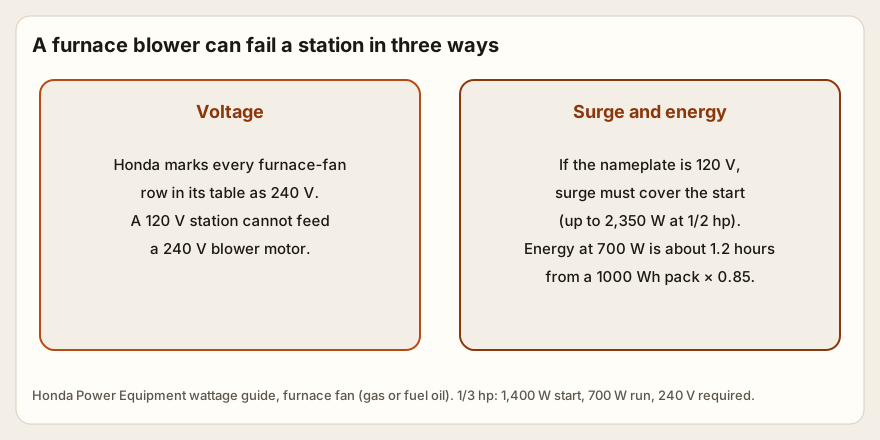
Every furnace-fan row in Honda’s table has a 240 V flag
Honda lists the following approximate loads for a furnace fan using gas or fuel oil:
| Furnace-fan size | Starting watts | Running watts | 240 V required? |
|---|---|---|---|
| 1/8 hp | 500 W | 300 W | Yes |
| 1/6 hp | 750 W | 500 W | Yes |
| 1/4 hp | 1,000 W | 600 W | Yes |
| 1/3 hp | 1,400 W | 700 W | Yes |
| 1/2 hp | 2,350 W | 875 W | Yes |
These are Honda’s examples, not a survey of furnace installations. They do not establish the voltage of the equipment in your home. Read the furnace and blower nameplates, then the installation manual. If the equipment specifies 120 V, use its own electrical requirements rather than treating Honda’s 240 V row as a model-specific specification.
The North American stations in our 1000 Wh outage guide have 120 V outputs. A 120 V inverter cannot directly supply the 240 V loads above. More battery capacity does not fix that mismatch.
Starting watts and running watts answer different questions
The inverter must handle the motor start and sustain the running load. Neither requirement tells you how long the battery will last.
Use the generator and power station wattage calculator to compare starting and running watts for the blower and other selected loads.
Honda’s 2,350 W start for the 1/2 hp example is close to the 2,400–3,000 W peak or surge labels published for the stations linked below. Its 1,400 W start for the 1/3 hp example is lower. Those comparisons are not compatibility approvals: surge duration and the manual’s motor restrictions matter. Anker’s 2,400 W SurgePad label is not automatically equivalent to a motor-start rating.
The table’s 300–875 W running loads fall below the stations’ published 1,500–1,800 W continuous ratings. That only checks watts. Honda’s voltage flags still rule out a direct connection to a 120 V model.
Use the furnace maker’s specified running and starting requirements when available. If the label lists amps but no watts, ask the maker for the electrical load. Volts × amps alone is not real motor power, so it is not a reliable shortcut for battery-runtime math.
A 1000 Wh pack gives blower-on hours, not heating hours
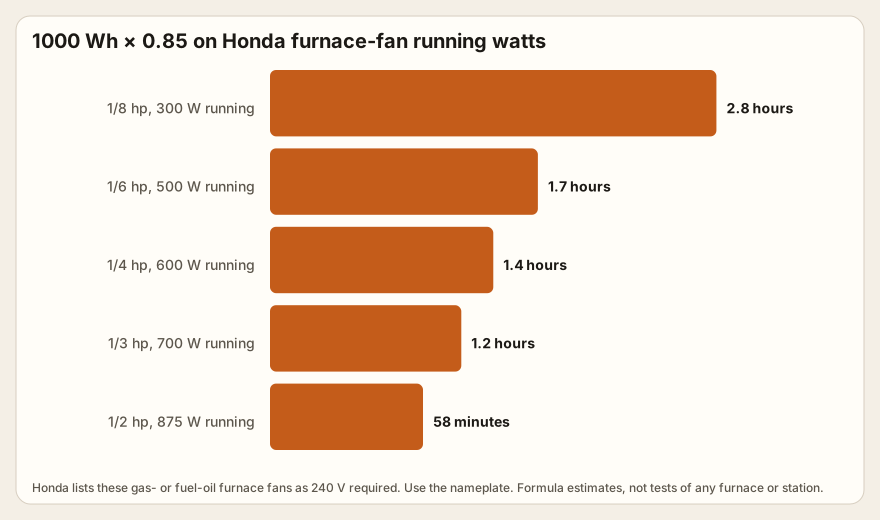
Each row below assumes continuous operation at Honda’s running watts, no other load, and a supply that meets the voltage and starting requirements. The chart shows energy math only; it does not establish compatibility.
| Honda running load | Calculation, hours | Estimate |
|---|---|---|
| 300 W, 1/8 hp | 1000 × 0.85 ÷ 300 | 2.8 hours |
| 500 W, 1/6 hp | 1000 × 0.85 ÷ 500 | 1.7 hours |
| 600 W, 1/4 hp | 1000 × 0.85 ÷ 600 | 1.4 hours |
| 700 W, 1/3 hp | 1000 × 0.85 ÷ 700 | 1.2 hours |
| 875 W, 1/2 hp | 1000 × 0.85 ÷ 875 | 0.97 hours, or 58 minutes |
For the last row, 1000 × 0.85 ÷ 875 × 60 ≈ 58 minutes. Rounding the result does not make it a guaranteed shutoff time.
A blower that cycles with the thermostat can spend part of an outage off. We do not have a sourced duty cycle for your house, thermostat, or weather. We cannot stretch the 1.2-hour row into a full night on that basis. The station can also draw energy while the blower is idle, which the simple formula does not model separately.
Ignition, controls, or a condensate pump can add electrical demand outside Honda’s fan row. A technician needs to account for the complete system and its connection requirements. Do not assume that powering the blower establishes that the furnace will heat safely.
Blower electricity is not electric space heating
A gas- or oil-furnace fan moves air; its listed watts are not a whole-system heating budget. An electric resistance heater is a different load.
For a heater if its nameplate says 1,500 W, the same worked battery gives 1000 × 0.85 ÷ 1500 × 60 = 34 minutes of continuous operation. That is a conditional label example, not a new Honda furnace specification. The window AC and space-heater guide separates those high loads from motor starting requirements.
Ready.gov advises going to a community location with power if heat or cold is extreme. It also warns against using a gas stove or oven to heat a home. A small battery calculation is not a substitute for that safety plan.
Take the nameplate and manual to a qualified technician
- Match voltage and phase. Read the actual system labels rather than relying on a generic horsepower table.
- Identify the full electrical load. Include controls and other equipment needed for heating, not only the fan.
- Check inverter restrictions. Use the regional station manual for continuous output, starting capability, and motor-load limits.
- Have the connection assessed. A qualified technician should review furnace operation; any connection to building wiring needs a qualified electrician and an approved transfer arrangement. Rental property also needs the required owner permissions.
Do not improvise a connection from the station’s AC output to a wall outlet. CPSC warns against that backfeeding connection for generators, and a battery inverter creates the same wiring hazard. The renters guide explains the distinction between plugging an appliance into a station and feeding building wiring.
Sources
- Honda Power Equipment, Wattage estimation guide: furnace fan, gas or fuel oil, 1/8 through 1/2 hp; starting and running watts above, all marked 240 V required.
- Jackery Explorer 1000 V2 basic information: 1,500 W continuous, 3,000 W instantaneous.
- EcoFlow DELTA 2 US product page: 1,800 W continuous, 2,700 W surge.
- BLUETTI AC180 US product page: 1,800 W continuous, 2,700 W surge.
- Anker SOLIX C1000 US product page: 1,800 W continuous, 2,400 W SurgePad.
- Ready.gov, Power outages: extreme-temperature planning and the warning against heating a home with a gas stove or oven.
- US CPSC, Portable Generator Hazards, Publication 5123: backfeeding and electrical hazards.
Try the estimate with your own numbers
For planning, a useful first estimate of how long a portable power station can run a load is:
Runtime (hours) ≈ battery capacity (Wh) × inverter efficiency ÷ load (W)
We use 0.85 as a conservative inverter-efficiency factor when a manufacturer does not publish one. That is a planning assumption, not a lab measurement. Some makers publish a similar figure: BLUETTI, for example, lists inverter efficiency of 85% for the AC180, and also subtracts depth of discharge and the station’s own standby draw.
Use this calculator for the simple form of the estimate. It runs in your browser and does not send any data.
This is not a test result. Real runtime also depends on depth of discharge, standby consumption, temperature, battery age, and whether the load cycles (a refrigerator) or runs continuously (a lamp). For surge versus running watts, see the article notes below: the inverter must cover the motor’s starting surge even if average watts look small.
Frequently asked questions
How many watts does a furnace blower use?
Honda’s wattage estimation guide lists gas- or fuel-oil furnace fans by horsepower: 1/8 hp at 500 W start and 300 W run; 1/6 hp at 750 / 500 W; 1/4 hp at 1,000 / 600 W; 1/3 hp at 1,400 / 700 W; 1/2 hp at 2,350 / 875 W. Every one of those rows is marked 240 V required. Your nameplate may differ; use it.
Can a 120 V power station run a furnace blower?
Not if the blower is 240 V, which is how Honda labels the entire table. A typical 120 V portable station cannot feed 240 V. If your nameplate is 120 V, the inverter still has to cover the starting surge (up to 2,350 W on Honda’s 1/2 hp row) and the running watts, and a 1000 Wh pack at 700 W is only about 1.2 hours using Wh × 0.85 ÷ W.
Will this keep my whole furnace running in an outage?
This article is about the blower motor’s published watts, not a complete furnace system. Ignition, controls, a condensate pump, or an air conditioner on the same circuit can add load we have not sourced here. If the furnace is 240 V, a 120 V station will not run the system. A qualified technician should review the complete heating system before you try to back it up.