Guide
How Long Will a Power Station Run a Chest Freezer?
A 1000 Wh station estimates about 34 hours on a new ENERGY STAR chest freezer averaging 24.9 W. The estimate uses 218 kWh/year and a 0.85 planning factor, not a power-station test.
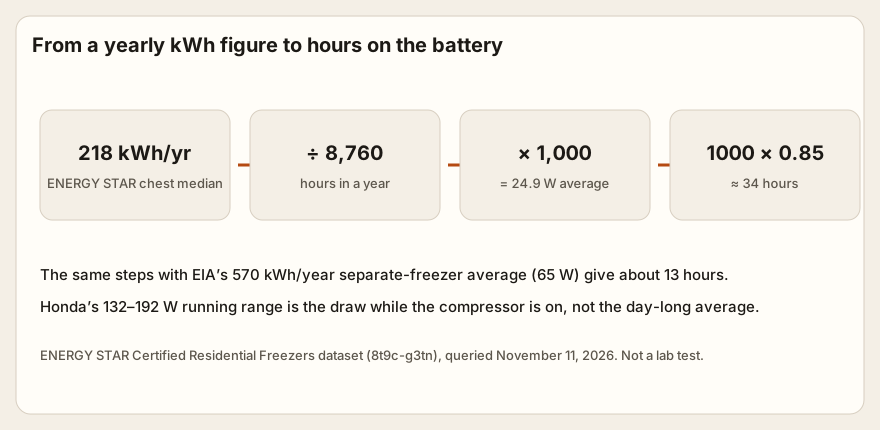
A 1000 Wh station estimates about 34 hours on a chest freezer averaging 24.9 W, if its inverter can start the compressor. That estimate converts 218 kWh/year as 218 ÷ 8,760 × 1,000 ≈ 24.9 W, then applies hours ≈ battery Wh × 0.85 ÷ average W, or 1000 × 0.85 ÷ 24.9 ≈ 34 hours. The 24.9 W is the median for 9 non-compact chest freezers in the ENERGY STAR dataset queried on November 11, 2026, not a measurement of your freezer.
We have not timed a chest freezer on a power station. The 0.85 is a planning factor, not a measured efficiency for one inverter. It stands in for conversion losses and usable capacity, but a station also consumes some power while its inverter is on. At a low freezer average such as 24.9 W, that idle consumption takes a larger share of the battery than it does at 162 W. Since no station model is specified here, use the maker’s idle or self-consumption figure when it publishes one instead of treating 0.85 as a guarantee.
The annual number and the compressor start answer different questions
On November 11, 2026, the ENERGY STAR Certified Residential Freezers dataset contained 680 certified models:
| Group in the official dataset | Models | Median annual use | Median capacity | Approximate average watts |
|---|---|---|---|---|
| Chest freezer, not compact | 9 | 218 kWh/year | 10.6 cu ft | 24.9 W |
| Upright freezer, not compact | 509 | 438 kWh/year | 15.5 cu ft | 50 W |
| Compact freezers | 162 | 244 kWh/year | Not supplied here | 27.9 W |
For every row, average W ≈ annual kWh ÷ 8,760 × 1,000. The 8,760 is the number of hours in a non-leap year. For example, the chest row is 218 ÷ 8,760 × 1,000 ≈ 24.9 W. Annual kWh already account for compressor cycling in the standardized rating, so do not divide that average by another guessed duty cycle.
The nine-model chest group is a small set. It describes current certified listings, not every older chest freezer in a garage. The ENERGY STAR freezer product page rounds the certified figures to about 215 kWh/year for a chest freezer and about 395 kWh/year for an upright. Those page figures and the dataset medians are both program figures, not a second lab result or a promise about one appliance.
The installed base is different. EIA’s 2020 RECS Table CE5.3b, revised March 2024, puts a separate freezer at 570 kWh/year, or 570 ÷ 8,760 × 1,000 ≈ 65 W. That is a household average for freezers people already own, chest or upright. It can be a more cautious starting point when you do not have the label for your freezer.
Honda’s wattage estimation guide lists an ENERGY STAR refrigerator or freezer at about 1,200 W to start and 132–192 W while the compressor is on. The start figure is the short demand the inverter must survive. The 132–192 W range is not the 25–65 W day-long average from annual kWh.
Worked hours for a 1000 Wh pack
Enter your freezer’s average watts and battery capacity in the battery runtime calculator to estimate hours with the same planning factor.
Use the same relationship for each load:
Runtime (hours) ≈ battery Wh × 0.85 ÷ average W
The table keeps the inputs visible so you can replace them with your label’s annual kWh or your station’s actual capacity.
| Battery | Load basis | Average watts | Estimated hours |
|---|---|---|---|
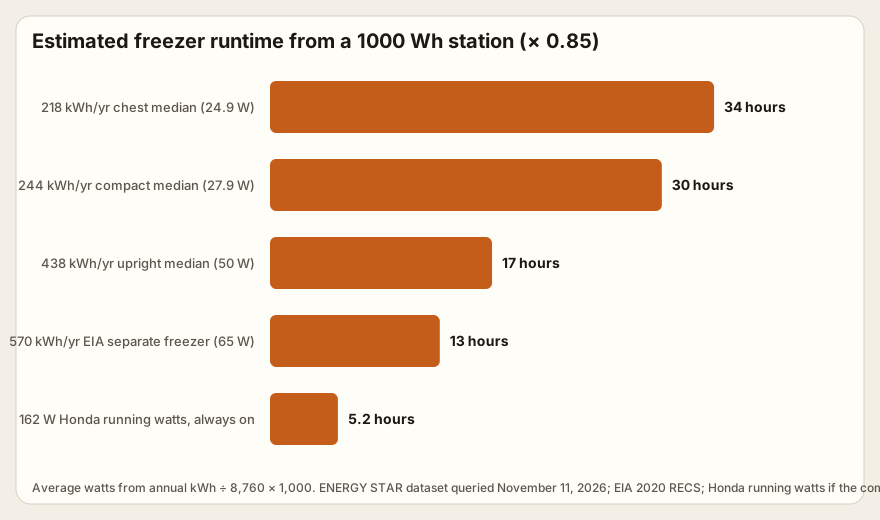
| 1000 Wh | ENERGY STAR chest median, 218 kWh/year | 24.9 W | 34 hours |
| 1000 Wh | ENERGY STAR upright median, 438 kWh/year | 50 W | 17 hours |
| 1000 Wh | ENERGY STAR compact median, 244 kWh/year | 27.9 W | 30 hours |
| 1000 Wh | EIA separate-freezer average, 570 kWh/year | 65 W | 13 hours |
| 1000 Wh | Honda running-range midpoint, compressor held on | 162 W | 5.2 hours |
For the Honda row, the midpoint is (132 + 192) ÷ 2 = 162 W. The corresponding arithmetic is 1000 × 0.85 ÷ 162 ≈ 5.2 hours. That row shows why compressor-on watts should not be treated as a day-long average for a cycling freezer.
A warm garage, a lid that opens often, or a thick frost load can pull more energy than the standardized conditions behind annual kWh figures. ENERGY STAR also says manual-defrost freezers use less energy than automatic-defrost models when they are actually defrosted, and that a chest often loses less cold air than an upright because its lid opens upward. Those are program statements, not tests we ran.
The 0.85 calculation does not predict every compressor start, defrost cycle, or inverter behavior. If the station maker publishes a formula with depth of discharge, inverter efficiency, and self-consumption, use those model-specific inputs. At a low load, an inverter’s idle draw can materially reduce the usable energy. Idle consumption is not listed as a separate row because no station model is specified here.
Keeping food cold is a separate clock
Ready.gov says a full freezer stays cold for about 48 hours if it stays closed. That is food safety guidance, not battery runtime. A station that runs out sooner does not make the 48-hour figure longer, and opening the lid spends some of the freezer’s cold reserve.
If you need to keep the freezer powered, check the station’s continuous AC rating and surge rating against the freezer’s manual or nameplate. A larger battery can provide more estimated hours, but it does not automatically provide a stronger inverter start. Plug the freezer directly into the station’s rated outlet, not into a building outlet fed from the station.
Read your label before choosing an input
- Find annual kWh on the EnergyGuide label or in the ENERGY STAR product finder. If the label is gone, use 218 kWh/year for the new certified chest median or 570 kWh/year for EIA’s separate-freezer average as a stated comparison, not as a claim about your model.
- Convert annual energy to average power: annual kWh ÷ 8,760 × 1,000. For a 400 kWh/year label, the reproducible calculation is 400 ÷ 8,760 × 1,000 ≈ 45.7 W.
- Estimate hours with battery Wh × 0.85 ÷ average W. Replace 1000 Wh with the capacity printed for your station.
- Check the freezer’s starting and running requirements against the station’s surge and continuous ratings. Also check voltage and the station manual’s compressor restrictions.
- Leave margin for heat, frost, door openings, an aging battery, and inverter idle consumption. A result rounded to an hour is an estimate, not a promise that the freezer will stay powered until that hour.
For the kitchen refrigerator, see How long will a power station run a refrigerator. For other loads that fit a 1 kWh pack, see the outage guide.
For an electricity-bill estimate from the freezer’s annual kWh, use the appliance electricity cost calculator.
Sources
- ENERGY STAR Certified Residential Freezers dataset (8t9c-g3tn), queried November 11, 2026 (680 models; 9 non-compact chest, median 218 kWh/year).
- ENERGY STAR, Freezers product page (about 215 kWh/year for a certified chest freezer; about 395 kWh/year for a certified upright; chest lids and manual-defrost notes).
- US EIA, Table CE5.3b, 2020 RECS (revised March 2024), separate freezer, 570 kWh/year.
- Honda Power Equipment, Wattage estimation guide (ENERGY STAR refrigerator or freezer, about 1,200 W start and 132–192 W run).
- Ready.gov, Power outages (about 48 hours in a full, closed freezer).
Try the estimate with your own numbers
For planning, a useful first estimate of how long a portable power station can run a load is:
Runtime (hours) ≈ battery capacity (Wh) × inverter efficiency ÷ load (W)
We use 0.85 as a conservative inverter-efficiency factor when a manufacturer does not publish one. That is a planning assumption, not a lab measurement. Some makers publish a similar figure: BLUETTI, for example, lists inverter efficiency of 85% for the AC180, and also subtracts depth of discharge and the station’s own standby draw.
Use this calculator for the simple form of the estimate. It runs in your browser and does not send any data.
This is not a test result. Real runtime also depends on depth of discharge, standby consumption, temperature, battery age, and whether the load cycles (a refrigerator) or runs continuously (a lamp). For surge versus running watts, see the article notes below: the inverter must cover the motor’s starting surge even if average watts look small.
Frequently asked questions
What should I check before plugging in a chest freezer?
Check the station’s continuous and surge ratings against the freezer’s running and starting requirements. Honda lists an ENERGY STAR refrigerator or freezer at about 1,200 W to start and 132–192 W while the compressor is on. Those are different from the 24.9 W day-long average calculated from 218 kWh/year. The Honda figures are a planning reference, not a measurement of your freezer, so use the freezer and station manuals when they provide model-specific values.
Can I use my freezer’s EnergyGuide label instead of the averages here?
Yes. Use the label’s annual kWh: average W ≈ annual kWh ÷ 8,760 × 1,000, then estimate hours with battery Wh × 0.85 ÷ average W. A label or product listing for your model is more useful than a median for a group of certified models. The 0.85 factor remains an assumption unless your station maker publishes a model-specific efficiency and standby calculation.
What if the battery runs out before the outage ends?
Keep the lid closed. Ready.gov says a full freezer stays cold for about 48 hours when it stays closed. That is a food-safety holding estimate, not extra battery runtime. If you use a station, reserve capacity for compressor starts and account for the station’s own inverter draw, which is a larger share of the energy budget at a low average load such as 24.9 W.