Guide
Can a Power Station Run a Sump Pump?
A 120 V station cannot run the 240 V sump pumps in Honda’s table. At the table’s 800 W running load, a compatible 1000 Wh station estimates to 64 minutes of continuous pump time.
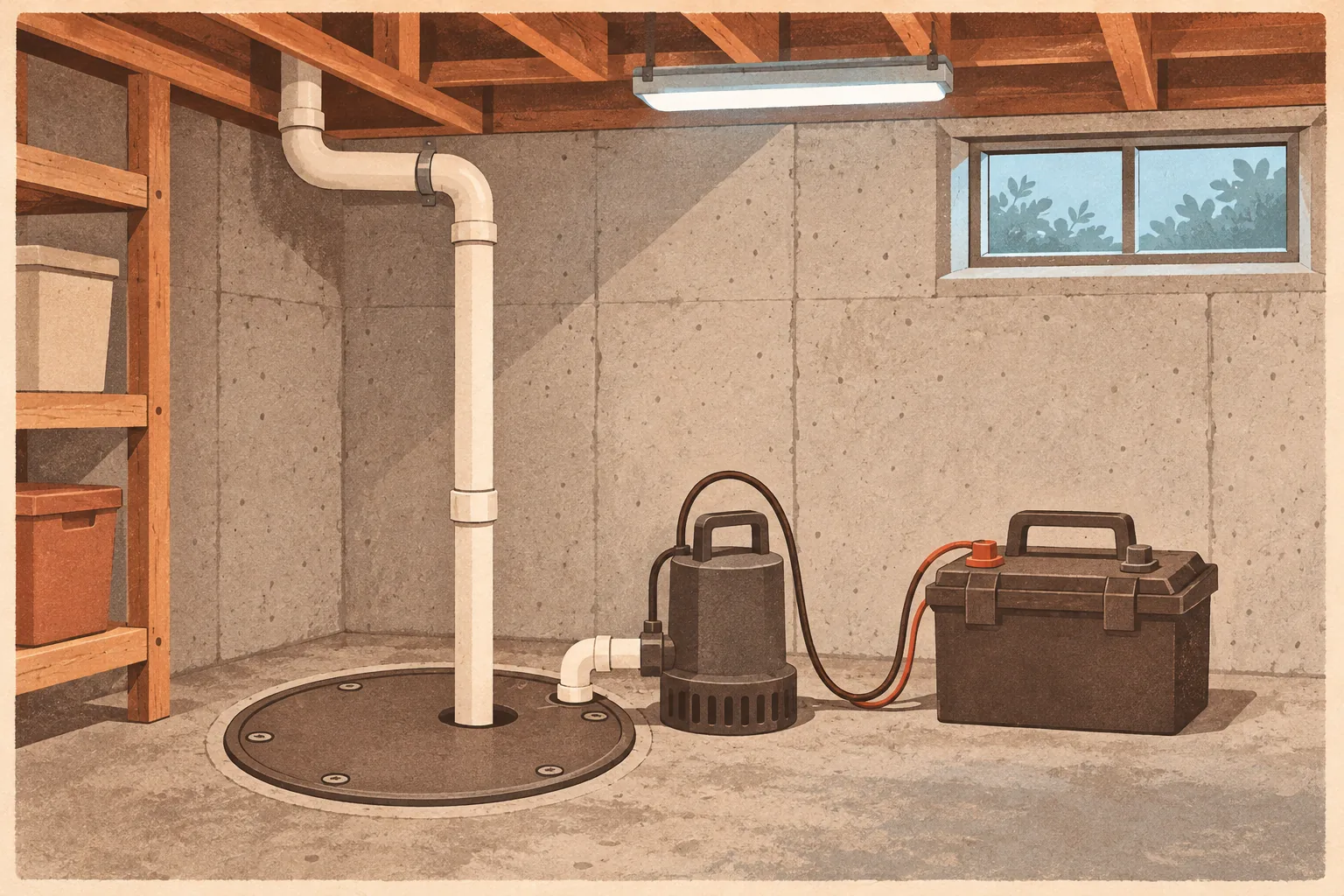
A power station can run a sump pump only if its output voltage and motor-start capability match the pump; a 120 V station cannot run the 240 V examples in Honda’s wattage guide. At Honda’s 800 W running load, a compatible 1000 Wh station estimates to about 64 minutes of continuous pumping: hours ≈ battery Wh × 0.85 ÷ running W, so 1000 × 0.85 ÷ 800 ≈ 1.06 hours, or 1.06 × 60 ≈ 64 minutes.
We have not tested a sump pump on a power station. These are published wattage estimates and energy math. The 0.85 factor is an assumption, not a measured efficiency for your inverter, and 1000 Wh is a worked battery capacity.
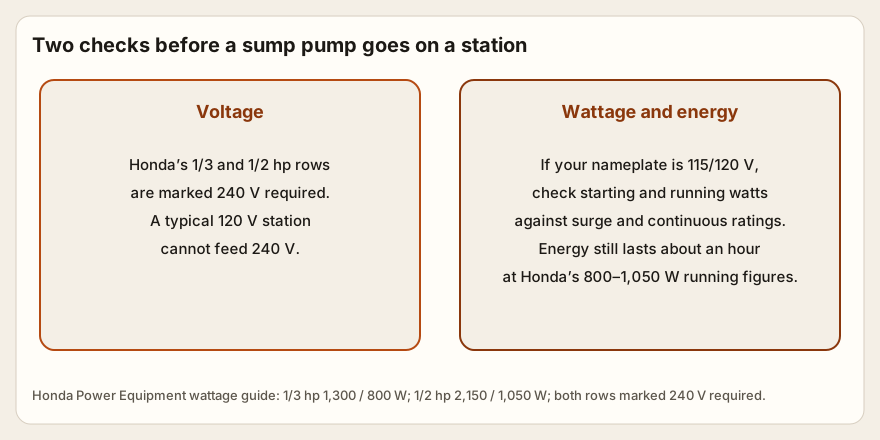
Honda flags both sump-pump rows as 240 V
Read the voltage column before comparing watts. Honda publishes these approximate loads:
| Honda row | Starting watts | Running watts | 240 V required? |
|---|---|---|---|
| Sump pump, 1/3 hp | 1,300 W | 800 W | Yes |
| Sump pump, 1/2 hp | 2,150 W | 1,050 W | Yes |
Those flags describe Honda’s examples, not every residential sump pump. Use the voltage on your pump’s nameplate and the output specification for your regional station. Do not assume that a matching plug or a large watt-hour number settles compatibility.
The North American models in the 1000 Wh outage guide have 120 V outputs. They cannot directly power the 240 V loads in this table. If your pump instead calls for 115 V or 120 V, confirm the permitted supply in its manual, then check its own starting and running requirements. Honda’s figures are comparison loads, not specifications for that different pump.
A peak label is not proof that the motor will start
Starting watts are a short demand when the motor turns on. Running watts are what it needs after that start. The station has to handle both, with any other connected loads counted too.
The generator and power station wattage calculator lets you compare a pump’s starting and running watts with other loads.
The manufacturers linked below publish continuous output of 1,500–1,800 W and peak or surge labels of 2,400–3,000 W for the stations in the outage guide. Honda’s 1,300 W and 2,150 W starts fall below those headline peak figures. That comparison does not prove motor compatibility. Surge duration and the manual’s load restrictions still matter. Anker’s 2,400 W SurgePad label is not automatically a motor-start rating.
Likewise, 800 W and 1,050 W fall below those continuous output ratings only as a wattage comparison. It does not remove the voltage mismatch in Honda’s table.
Use a starting figure from the pump maker when available. If the nameplate lists only amps, do not treat volts × amps as measured motor watts. Ask the maker for the supply and starting requirements rather than filling the gap with a guessed surge multiplier.
Pump-on minutes are not elapsed outage hours
The table spends the entire worked 1000 Wh capacity on one load. For comparison, EIA’s most-used refrigerator average is 617 kWh/year: 617 ÷ 8,760 × 1,000 ≈ 70 W, using the hours in a non-leap year.
| Load basis | Runtime calculation | Estimate |
|---|---|---|
| EIA most-used refrigerator, 70 W average | 1000 × 0.85 ÷ 70 | About 12 hours |
| Honda 1/3 hp sump, 800 W running | 1000 × 0.85 ÷ 800 | About 1.06 hours, or 64 minutes |
| Honda 1/2 hp sump, 1,050 W running | 1000 × 0.85 ÷ 1,050 | About 0.81 hours, or 49 minutes |
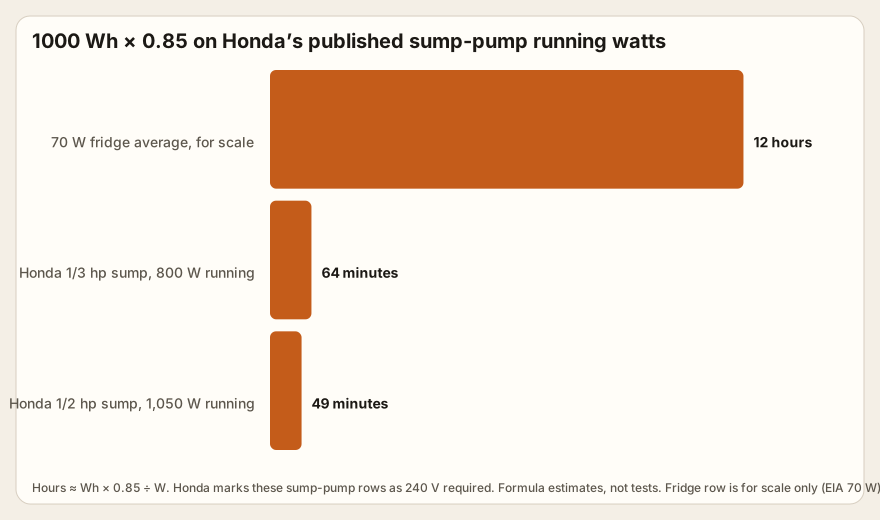
A pump controlled by a float switch does not necessarily run throughout the outage. Pauses can spread those pump-on minutes over more elapsed time. We do not have a sourced duty cycle for your basin, water inflow, or storm, so we cannot turn 64 minutes of continuous operation into a promise of overnight protection.
The inverter can also use energy while waiting for the next start. Our single planning factor does not separately model that idle draw. Nor does it predict cold-battery performance or battery aging. Use the maker’s runtime method when it covers this load.
If a motor start trips the station, stored energy alone will not keep the basement dry. A successful initial start also does not establish that every later float-switch cycle will work.
Read these labels before relying on the setup
- Pump voltage and phase. Compare the nameplate with the station’s regional output. A 240 V pump is not a direct load for a 120 V station.
- Pump starting and running requirements. Use the manual or ask the pump maker. Horsepower alone does not establish electrical compatibility.
- Station continuous output, surge limits, and AC settings. Check motor restrictions and any auto-off behavior during idle periods.
- Placement and connection rules. Confirm that a dry, ventilated spot near the pump is allowed under the lease and meets the station manual. Keep the battery out of water and clear of rising floodwater. Do not backfeed a household outlet.
CPSC’s Publication 5123 warns that feeding a generator into a wall outlet can electrocute utility workers and bypass household protection. Feeding that receptacle from a battery inverter creates the same connection hazard. The renters guide covers direct appliance connections and the need for a qualified electrician for building wiring.
At Honda’s running loads, this battery size offers a short energy budget. Do not call it a multi-day sump plan without the pump’s actual requirements and a recharge plan.
Sources
- Honda Power Equipment, Wattage estimation guide: 1/3 hp sump pump, 1,300 W start and 800 W run; 1/2 hp, 2,150 W start and 1,050 W run; both marked 240 V required.
- Jackery Explorer 1000 V2 basic information: 1,500 W continuous, 3,000 W instantaneous.
- EcoFlow DELTA 2 US product page: 1,800 W continuous, 2,700 W surge.
- BLUETTI AC180 US product page: 1,800 W continuous, 2,700 W surge.
- Anker SOLIX C1000 US product page: 1,800 W continuous, 2,400 W SurgePad.
- US EIA, 2020 RECS Table CE5.3b, revised March 2024: most-used refrigerator, 617 kWh/year.
- US CPSC, Portable Generator Hazards, Publication 5123: backfeeding and electrical hazards.
Try the estimate with your own numbers
For planning, a useful first estimate of how long a portable power station can run a load is:
Runtime (hours) ≈ battery capacity (Wh) × inverter efficiency ÷ load (W)
We use 0.85 as a conservative inverter-efficiency factor when a manufacturer does not publish one. That is a planning assumption, not a lab measurement. Some makers publish a similar figure: BLUETTI, for example, lists inverter efficiency of 85% for the AC180, and also subtracts depth of discharge and the station’s own standby draw.
Use this calculator for the simple form of the estimate. It runs in your browser and does not send any data.
This is not a test result. Real runtime also depends on depth of discharge, standby consumption, temperature, battery age, and whether the load cycles (a refrigerator) or runs continuously (a lamp). For surge versus running watts, see the article notes below: the inverter must cover the motor’s starting surge even if average watts look small.
Frequently asked questions
Will a 1000Wh power station run a sump pump?
Only if the voltage matches and the inverter can cover starting and running watts. Honda’s 1/3 hp and 1/2 hp sump-pump rows are marked 240 V required. A typical 120 V portable station cannot feed a 240 V pump. If your nameplate is 115 or 120 V, Honda’s 1,300 W start and 800 W run (1/3 hp) or 2,150 W start and 1,050 W run (1/2 hp) still have to fit the station’s surge and continuous ratings.
How long will a 1000Wh station last on a sump pump?
At Honda’s 800 W running figure, 1000 × 0.85 ÷ 800 ≈ 1.06 hours, about 64 minutes. At 1,050 W, the same formula is about 49 minutes. That assumes the pump runs continuously at those watts. A pump that only cycles after rain will use less energy, but each start still needs the surge rating, and we do not have a sourced duty cycle to turn that into a longer official estimate.
Why does Honda say 240 V for a sump pump?
That is how Honda labels the 1/3 hp and 1/2 hp rows in its wattage estimation guide. It is not a census of every residential pump. Read the nameplate on yours. If it says 240 V, a 120 V station will not run it, no matter how many watt-hours the battery holds.