Guide
Generator vs Power Station for Apartments
A 1000 Wh battery estimates to about 12 hours on a 70 W refrigerator average, while a gasoline generator is not safe to run indoors. Compare the safety limits, load math, and apartment tradeoffs without treating this as a product test.
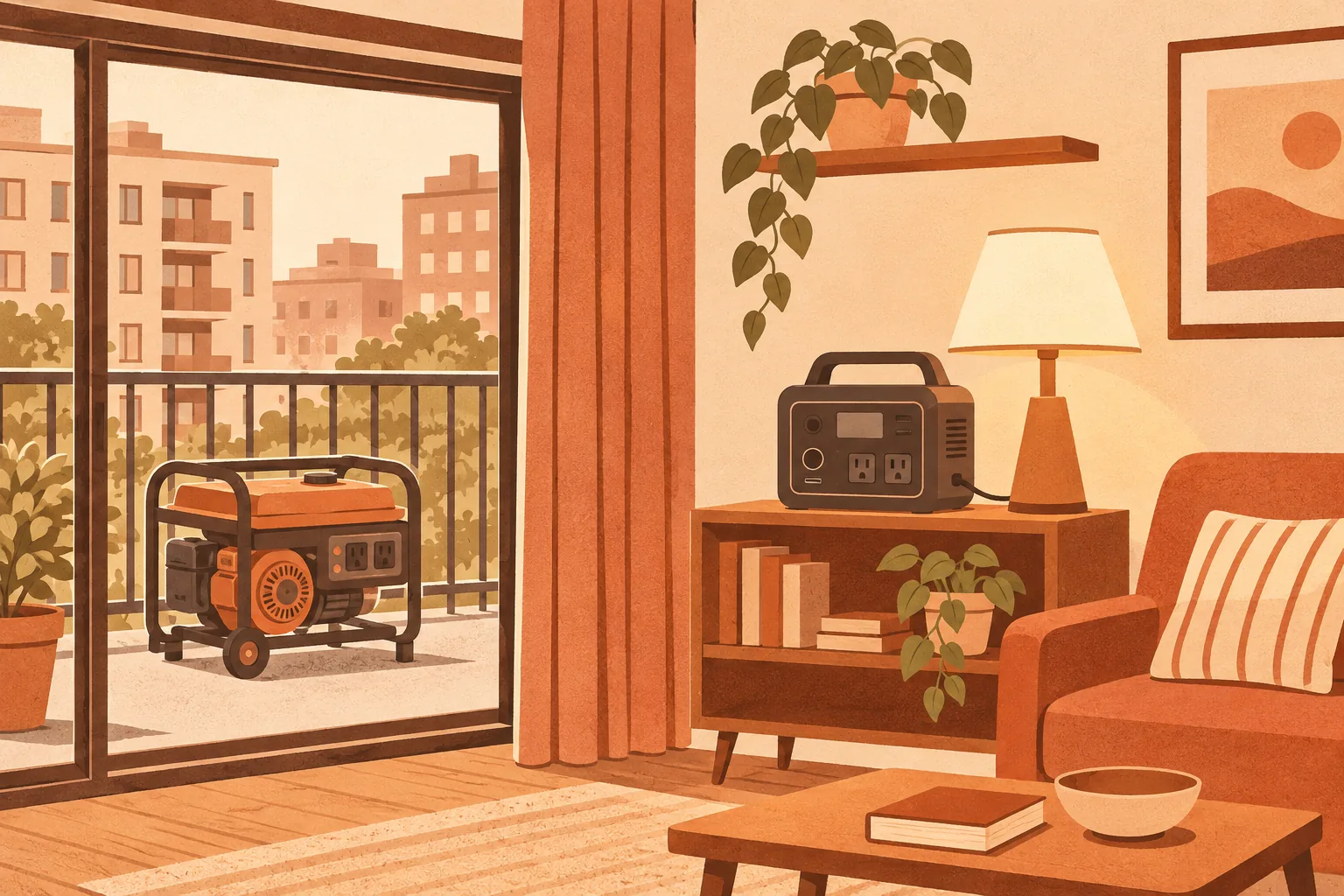
For an apartment, a 1000 Wh power station is the indoor option: on a refrigerator averaging 70 W, 1000 × 0.85 ÷ 70 ≈ 12 hours, while a gasoline generator is not safe to run indoors. The 0.85 factor is an explicit planning assumption, not measured efficiency, and the estimate assumes the station’s inverter can start the refrigerator.
We have not run either device in an apartment. These are calculations from manufacturer specifications and official datasets, not a generator test, battery test, or lease recommendation.
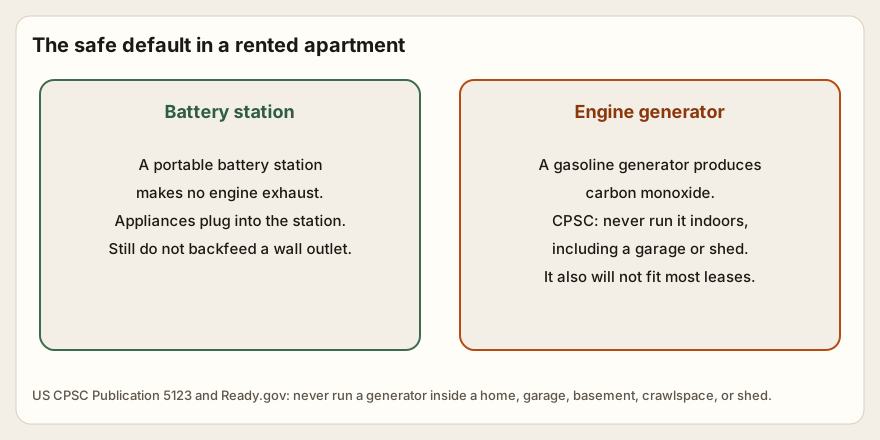
A generator needs an outdoor site an apartment may not have
CPSC Publication 5123 warns that generator exhaust contains carbon monoxide and says never to run a portable generator inside a home, garage, basement, crawlspace, shed, or similar enclosed space. Open windows, doors, and fans do not make indoor operation safe.
Ready.gov says a generator belongs outdoors, at least 20 feet from windows, doors, and attached garages. Outdoors is not the same as approved. Do not treat a balcony, fire escape, hallway, roof, or parking spot beneath a window as a safe exception. This article does not clear any location for generator use. Check the lease, building rules, fire rules, and local requirements yourself.
A battery station has no engine exhaust, so that carbon monoxide hazard from a fuel engine does not apply to the battery pack. It still needs the placement, ventilation, temperature, and clearance rules in its own manual. Keep vents open and exits clear. A station that is safe from exhaust can still be unsafe if its maker forbids the location or if a cord creates a trip hazard.
The wall outlet is not a generator connection
CPSC also warns against backfeeding, which means connecting a generator to building wiring through a wall receptacle. That can energize wiring unexpectedly, electrocute utility workers or neighbors, and bypass circuit protection.
A battery inverter does not make that connection safe. Plug the refrigerator, lamp, charger, or other appliance directly into the station, using a properly rated cord and the manuals for both devices. A permanent connection to building wiring needs an approved transfer arrangement installed by a qualified electrician and permission from the property owner. The renter guide covers this wiring limit in more detail.
Do not compare a generator’s possible fuel runtime with a battery’s watt-hours as if they were the same published measure. We do not invent a generator runtime without a specific model, tank, load, and manufacturer test or formula.
What a worked 1000 Wh comparison covers
The simple planning formula is:
Runtime (hours) ≈ battery capacity (Wh) × 0.85 ÷ load (W)
The 1000 Wh capacity here is a worked example, not a claim about one product. The 0.85 factor is an assumption for planning. A maker may account for depth of discharge, inverter efficiency, self-consumption, temperature, or reserve capacity differently.
| Load | Input used | Formula estimate from 1000 Wh × 0.85 |
|---|---|---|
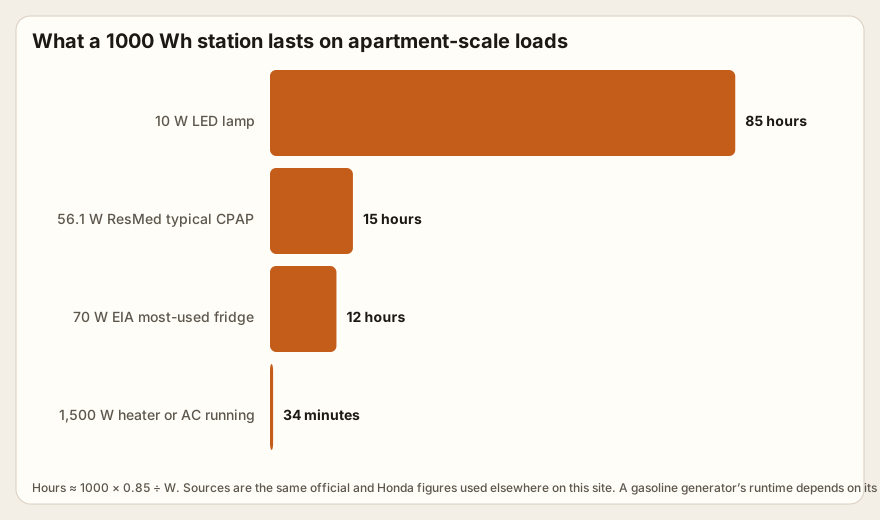
| LED lamp, hypothetical 10 W label input | 10 W | ≈ 85 hours |
| ResMed AirSense 11 typical published consumption | 56.1 W | ≈ 15 hours |
| EIA most-used refrigerator average | 70 W | ≈ 12 hours |
| 1,500 W heater, hypothetical nameplate input | 1,500 W | ≈ 34 minutes |
| Honda 10,000 BTU window AC running figure | 1,500 W | ≈ 34 minutes |
The 10 W LED row is a hypothetical label input, not a researched typical lamp draw. Replace it with the wattage printed on your lamp. The 1,500 W heater row is also a hypothetical nameplate input, not a researched typical heater value. It shows what the formula does at that label.
Honda separately lists a 10,000 BTU window air conditioner at about 2,200 W starting and 1,500 W running in its wattage guide. Even when a station can carry the running load, its surge limit must cover the AC start.
ResMed’s AirSense 11 guide gives the 56.1 W typical figure used above. EIA’s 2020 RECS Table CE5.3b gives 617 kWh/year for the most-used refrigerator, which converts to about 70 W using 617 ÷ 8,760 × 1,000 ≈ 70 W. Annual refrigerator use includes compressor-off time, so an average-watt runtime estimate and a compressor starting-watt check answer different questions.
The fridge can last hours, but its compressor starts higher
Honda lists an ENERGY STAR refrigerator or freezer at about 1,200 W starting and 132–192 W running. Those are Honda’s appliance examples, not measurements of the refrigerator in your apartment.
Check the appliance nameplate or manual and compare both figures with the station manual. The 70 W EIA average estimates battery energy use. It does not prove that the inverter will handle a compressor start. A station may have enough stored energy and still shut down when the compressor starts.
For a model-specific estimate, use the refrigerator’s annual kWh on its EnergyGuide label. The refrigerator guide explains how annual energy, starting watts, and the simple 0.85 planning factor fit together. Keep the refrigerator closed during an outage; Ready.gov gives about four hours of cold holding for a closed refrigerator and 48 hours for a full freezer. Those are food-holding estimates, not extra battery runtime.
High loads use the battery in minutes
At a hypothetical 1,500 W heater label, the calculation is 1000 × 0.85 ÷ 1500 ≈ 0.57 hours, or about 34 minutes. That is energy math only. The station also needs enough continuous AC output, and the heater plug and voltage must match the station and local wiring.
Honda’s window AC example also has to start, at 2,200 W. The 1,500 W running figure is at the published continuous limit of some 1 kWh-class stations and below the 1,800 W limits of others. A peak label alone does not prove that a particular compressor will start.
For a short outage, a 1000 Wh outage plan is more useful when it reserves energy for a refrigerator, lights, communications, or a medically appropriate CPAP instead of spending the pack on a heater. Ready.gov’s heat and cold guidance matters more than a 34-minute calculation if indoor conditions become dangerous.
Weight and recharge matter in a walk-up
The 1 kWh-class examples cited in the outage guide publish weights from about 10.8 to 16 kg. That range is a practical apartment constraint: plan where you can lift and store the station without blocking an exit or crossing a dark hallway with a cord.
| Station | Published weight |
|---|---|
| Jackery Explorer 1000 v2 | About 10.8 kg |
| EcoFlow DELTA 2 | About 12 kg / 27 lb |
| Anker SOLIX C1000 | 12.9 kg |
| BLUETTI AC180 | About 16 kg / 35.3 lb |
These are manufacturer specifications, not measurements by this site. The cited product pages also publish different capacities, output limits, and recharge inputs. Use the manual for the exact regional model rather than treating the 1000 Wh class as one standard device.
A station needs a way to recharge after the first estimate. Wall charging depends on the building circuit and the maker’s AC input limit. Solar charging depends on panel voltage, current, weather, orientation, and a location allowed by building rules. The solar recharge guide explains why an input cap is not a daily energy guarantee.
A short apartment checklist
- If it has a fuel engine, follow CPSC and Ready.gov: never run it indoors, and use the 20-foot outdoor siting guidance. Do not assume a balcony is approved.
- If it is a battery station, follow its placement and ventilation rules, keep exits clear, and plug appliances into its outlets.
- Read the appliance’s starting and running watts. Do not use a 70 W refrigerator average as its compressor-start requirement.
- Treat 10 W and 1,500 W rows above as hypothetical label inputs unless your own device label says otherwise.
- Plan a recharge source and check the lease and building rules before storing fuel, placing equipment, or arranging electrical work.
Sources
- US Consumer Product Safety Commission, Portable Generator Hazards, Publication 5123, carbon monoxide and backfeeding warnings.
- Ready.gov, Power outages, generator placement, extension cords, food holding, medical planning, and extreme-temperature guidance.
- US Energy Information Administration, 2020 RECS Table CE5.3b, most-used refrigerator energy use.
- ResMed, AirSense 11 Americas user guide, typical and peak power figures.
- Honda Power Equipment, Wattage estimation guide, refrigerator starting and running examples and 10,000 BTU window AC wattages.
- Jackery Explorer 1000 v2 basic information, capacity, output, and weight.
- EcoFlow DELTA 2 US product page, capacity, output, and weight.
- BLUETTI AC180 US product page, capacity, output, and weight.
- Anker SOLIX C1000 US product page, capacity, output, and weight.
Try the estimate with your own numbers
For planning, a useful first estimate of how long a portable power station can run a load is:
Runtime (hours) ≈ battery capacity (Wh) × inverter efficiency ÷ load (W)
We use 0.85 as a conservative inverter-efficiency factor when a manufacturer does not publish one. That is a planning assumption, not a lab measurement. Some makers publish a similar figure: BLUETTI, for example, lists inverter efficiency of 85% for the AC180, and also subtracts depth of discharge and the station’s own standby draw.
Use this calculator for the simple form of the estimate. It runs in your browser and does not send any data.
This is not a test result. Real runtime also depends on depth of discharge, standby consumption, temperature, battery age, and whether the load cycles (a refrigerator) or runs continuously (a lamp). For surge versus running watts, see the article notes below: the inverter must cover the motor’s starting surge even if average watts look small.
Frequently asked questions
Can I run a gas generator in an apartment or on a balcony?
No. The US CPSC says never to run a portable generator inside a home, garage, basement, crawlspace, or shed, even with doors and windows open. Ready.gov says to keep a generator outdoors and at least 20 feet from windows, doors, and attached garages. That guidance does not approve a balcony, hallway, fire escape, or parking space under a window. Check the building rules and local requirements before storing fuel or considering a generator.
What should I check if a refrigerator makes the station shut off?
Check the refrigerator’s starting watts and running watts against the station’s surge and continuous AC limits. Honda lists about 1,200 W starting and 132–192 W running for an ENERGY STAR refrigerator or freezer, but those are an example, not a measurement of your appliance. A 70 W average used for runtime does not describe the compressor’s starting spike.
How can I keep a power station going after the first day?
A battery station needs a recharge source. Wall charging uses the station’s published AC input limit, while solar charging requires a panel that fits the station’s voltage and current limits and a location allowed by the building. The 400–600 W solar caps cited for the example stations are input ceilings, not guaranteed daily energy. A fuel generator can run longer with fuel and a safe legal outdoor site, but this page does not estimate its fuel runtime.